I woke up this morning to find that my host mom had just taken a homemade cream cheese-filled pastry out of the oven, hot and fresh. Of course, I’ve only made a dent in my quiche, so I had a hearty slice of that, too. And, of course, a cup of coffee.
When I arrived at church, I realized one cup of coffee was not going to cut it. I had stayed up late the night before watching Westerns with my host family, enjoying another slice of homemade apple pie, and then blogging till well past midnight. I was definitely going to need more caffeine. None was to be found, so I sufficed with the homemade cookies my host mom had sent with me. I shared them with the group, too, to which at least one person responded “Thanks be to God!” An appropriate response to cookies, I think.
Still needing my coffee, I checked our schedule for the day. I was in luck. We were going to visit at least three churches! As I expected, the first had coffee freshly brewed and waiting for us. Along with a platter of freshly cut oranges and apples.
As we enjoyed the plentiful second breakfast, Wayne Frass spoke with us about his role as a Parish Ministry Associate, or PMA. (As I understand it, PMA’s serve many (though not all) of the same roles as pastors do, and are often commissioned to serve in places where there is no pastor to serve.) Wayne gave, in his own quiet and unassuming way, a very moving talk in which he spoke openly of his own faith and vocational journey. Today he works part-time as a PMA even as he is still fully a farmer, a balancing act that was never more clear than when he explained that he’ll have to cut back a bit in the next several weeks because it’ll be calving season.

I was particularly struck by a metaphor Wayne used to describe his own fears before preaching for the first time. “I was afraid these people were expecting steak,” he said, “but were going to get a cheese sandwich instead.” But, of course, Wayne preached the gospel, and everything was fine.
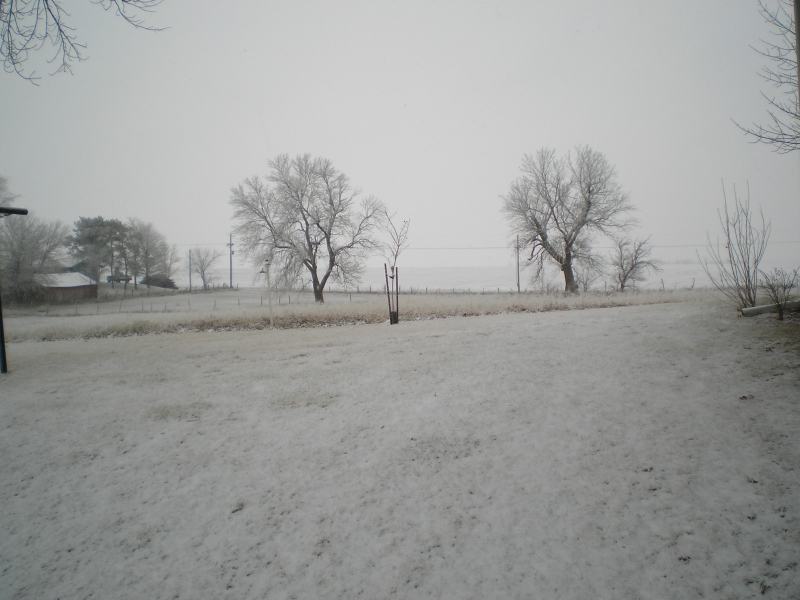
From Gloria Dei we went out to Sullivan Hills, a camp that is a part of Nebraska Lutheran Outdoor Ministries. When we arrived, they too had hot coffee waiting for us, along with some tasty little chocolate-topped bars. Besides refreshments, Sullivan Hills has wonderful facilities, well-furnished and well-equipped buildings with vast expanses of prairie fields for playing and hills for hiking and lots of space to take some time for spiritual retreat. We wandered the grounds for an hour or more, taking in the open air, walking across a frozen-over pond, and sitting a spell.

From Sullivan Hills we headed to a farm sale, or auction. We chatted up the farmers and checked out some of the equipment. Peter, our professor, almost bought a riding lawnmower, but decided the shipping costs would be too high. Jim and Annette discussed buying a tractor and getting into the business, or perhaps just trying some cow pies instead. All of us stopped for lunch here. The menu: Sloppy joes, baked beans, Mountain Dew in a can, and homemade cherry pie. D-licious.

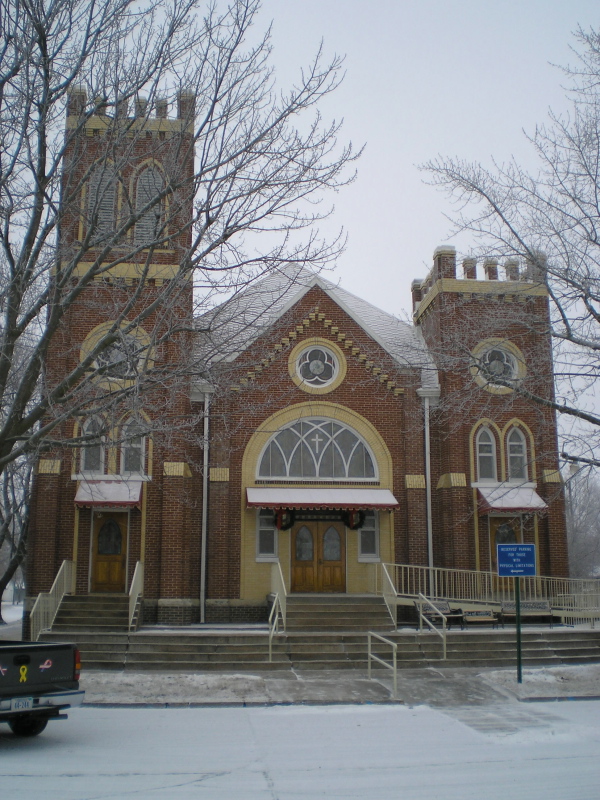
From there we visited Weyerts Immanuel Lutheran Church and marveled at its records that dated back to the 1880s (it even had pages where the pre-printed date was "18__ ".). We listened to the soon-to-be-retiring Pastor Wells, who serves Immanuel as part of a four-point (!) parish, speak of his many years of ministry and his bold and surprising (for us) vision for the future of the church. He’d like to see a model of more lay leaders (e.g. PMA’s) serving outlying churches and highly skilled pastors serving “hub” churches; he thinks this is the most sustainable model for rural ministry in the coming decades.
After drinking some more coffee, we visited an elementary school and then a high school, and then stopped by Trinity Lutheran in Dalton to visit with Bud Gillespie, a CLP, or the Presbyterian version of the PMA. Bud works with Pastor wells in the four-point parish. Both Bud and Pastor Wells are Presbyterian, and their four-point parish is made up of three Lutheran churches and one Presbyterian church. Their examples make it clear just how innovative rural churches have to be in order to find ministers for their congregations.
From Trinity we had to rush back to Sidney to make a church council meeting, so we ate at a Taco Bell/Kentucky Fried Chicken on the way. My host mom would be appalled to hear of this culinary choice, but all was not lost: I was able to try Mountain Dew: Tropical Lime Storm edition for the first time. It has a very strange color. I’ll leave it at that.
Finally we arrived back at Holy Trinity Lutheran Church in Sidney for a church council meeting. Brown Church Development, who helped Holy Trinity build their fantastic new addition two years ago, was giving a presentation to the council to begin Phase 2 of Holy Trinity’s building project. What was most fascinating about Brown’s presentation was their process. They describe it with colorful charts and graphics, but in short, the church discerns what their ministry needs are, prioritizes them, puts them into a document for all the church to see, and then Brown helps the church come up with a building plan to match their ministry needs. Obviously there are many more details in there (seriously), but the critical thing is that the congregation puts its ministry goals first.
After Brown left, we talked with church council members about the last several years of growth at Holy Trinity. Council member after council member made it abundantly clear that Holy Trinity grew spiritually in ways their new architectural additions only hinted at. Spiritual growth, both personal and communal, was at the center of their growth as a church.

This is a long post, reflective of another long day (thirteen hours from leaving home to arriving home). I’m worn out. But I can’t help feeling like this was a critical day for me personally, spiritually, and vocationally. I struggled to put my finger on why, until Wayne’s steak and cheese sandwich metaphor floated to the surface of my thoughts. Today I saw the deep hunger of these churches for pastoral leadership and spiritual nourishment. I saw the joyful excitement on the parishioners’ faces as they asked us what brought us to seminary. I heard our leader’s voice crack as he told us how much it meant to him that we were here. And it scares the crap out me. I want to help, but every time I imagine myself doing it I think my God, these people need a steak, and I am nothing but a cheese sandwich.
And then I remember the conclusion of Wayne’s story of stage fright. He preached the gospel, and the fear went away. And that’s what I saw today, too: the reality of the power of the gospel. The reality of the presence and love and grace and attention of God, even out here on the dry and drought-plagued Western plains where joy has no business flourishing, even here, where there should be only isolation and loneliness, even here God’s Spirit kindles a fire in the hearts of God’s people; the fire of the gospel burns within their hearts, and they are not afraid. They build the kingdom in spite of it all.
And the kingdom is growing, dear reader, make no mistake, the kingdom is growing. So when the call goes out – WORKERS NEEDED – remember this: Jesus turned water into wine. Surely he can turn a cheese sandwich into a steak.
MCK