As reported on Monday, the rumors were flying that the four unisolated students were in fact themselves flying across the snow fields on snowmobiles and four-wheelers. Turns out the rumors were true. The photos speak for themselves:
Patricia takes a ride on the wild side.
Kaila gets instructions so she doesn't get the four-wheeler stuck in the snow.
Becca is all smiles, despite getting the four-wheeler stuck in the snow.
Patricia, Kaila, Becca and Alpha couldn't gush enough about the great "off day" they had.
We walked out the door this morning and faced a temperature of -7 degrees (not wind chill). Tonight the low temperature with wind chill is predicted to be -32 degrees. There is at least a foot of snow on the ground and it is drifting to two feet or more.
I have joked with friends about traveling to enjoy the “bright sunshine, warm breezes, palm trees and ocean views” in Nebraska over J-term. I’m not wrong; just a few years too late:
Eastern Nebraska, circa 75 million years ago.
In the late Cretaceous period, three quarters of Nebraska was covered by a body of water known as the Great Inland Sea. Prehistoric sharks and plesiosaurs prowled the depths. Pretty cool stuff. You should look it up.
Eastern Nebraska, circa 20 hours ago.
In the Holocene epoch of the Quaternary period of the Cenozoic era (read: right now), three quarters of Nebraska is covered by fields of various grasses and crops. Livestock and combines prowl the lengths and widths of the fields. This is pretty cool stuff too (though maybe not as cool as sharks and plesiosaurs). Our immersion team doesn’t need to look it up; we just look outside the windows.
Yesterday, several of us expressed our disappointment that we did not have the chance for much downtime to process our visit thus far, nor a lot of time to spend with our host families.
Then it snowed… and snowed.
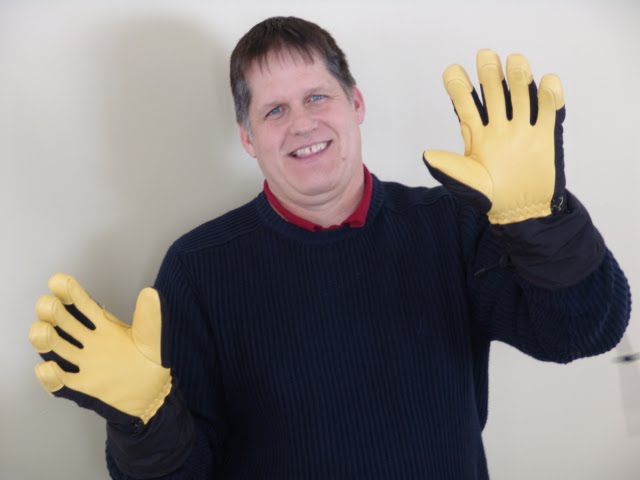
10-12 inches of snow later, with more on the way and “blustery” winds predicted, we found ourselves restricted to our guest quarters with plenty of downtime and the opportunity for considerable time with our host families. Lorin and I have been staying in the beautiful guest house of Mark and Bonnie Wagner. We accompanied Bonnie to the village of Petersburg after breakfast to collect some groceries before the predicted wind arose. The Wagners reported that when the snow builds up and the wind blows, drifting snow can become a significant hazard. We made it to town with no difficulty, perused the small grocery store (well-stocked with considerable variety of products), then in search of postcards we visited the wonderful and charming Leifeld’s, the hardware/furniture/clothing/toy/knickknack/and-just-about-everything-else store that one often finds in small towns. We found our postcards, and visited with the owner Jim Leifeld - who has lived there his entire life - about the town and some of its religious history. Lorin was pleased to purchase a snazzy pair of new gloves:
Is he showing off his gloves, or acting like a mime?
Then we headed back to the ranch, where we spent a lovely afternoon enjoying the silence of falling snow, bulls across the road slowly turning from black to white and quietly munching their hay, and soaking in the chance to simply be in Nebraska.
Breakfasting bulls.
Brian demonstrates that in a rural setting, sometimes the pastor will have to shovel the walkway.
We heard a rumor that some others in our group might be snowmobiling today. We’ll check into it and report back soon. Hopefully, there will be photos!
SUNDAY, JANUARY 9 – We awoke this morning to a light blanket of snow covering the ground. From our respective guest quarters we all headed into the town of Albion to worship at Zion Lutheran Church. We chatted with attendees of the early service and then met with around 20 members during the Sunday School hour. They all very graciously introduced themselves and shared some of their history in the area, what they loved about being in a rural setting, and what they looked for in a pastor, and then listened with appreciation to our questions and responses.
We attended the 10:30 worship service, and some of us noted the many representatives of different age groups, including what felt like “half the congregation” who ran to the front for the children’s sermon.
For lunch, we shared pizza and enlightening conversation with eight members of the Luther League, also known as the high school youth group. We told our call stories in brief, then listened to the youth explain to us what it’s like for them to live in a small town, what their goals and dreams are for the future, and what they do for fun. As a demonstration of the latter, they introduced us to the circular interactive games of “Ninja” and “Pterodactyl.” Trying to explain either of them in the space of this blog would require another entry at least… suffice it to say that hilarity ensued and a great bonding moment was shared by all.
Patricia and Alpha join in on playing "Pterodactyl." You'll just have to look it up.
After lunch, interim senior pastor Bob Johnson shared with us some insights and experiences from his 50 years of pastoring.
With the schedule changing nearly each hour as the snow continued to fall, Pastor Mike elected to take us to visit Albion’s funeral home, owned and operated by Ron Levander. Ron and his wife Mary shared with us many of the joys and challenges in the funeral home business, including some of the special considerations found in small towns. Ron tenderly explained that a significant difference between operating this business in a small town versus a large town or city is that in a town like Albion, where “everyone knows everyone,” he will almost always know personally the person who has died and their family and friends. This fact adds another element to the personal service provided by the funeral home that one is hard-pressed to find in an area of high population.
A brief respite back at the church, then a ride through the still-accumulating snow to the village of Petersburg (population approx. 300), where we ate a fried fish dinner at a benefit for Neil Claar, a local US Army soldier who was seriously wounded in Afghanistan by a suicide bomber. Despite the cold and snow (the latter of which was getting to be more than our van could take), the place was packed. Pastor Mike told us that Neil received a hero’s welcome when he finally returned home. Rural people are often proudly patriotic and treating a returning soldier with the respect that they have for Neil is something that they are honored to do.
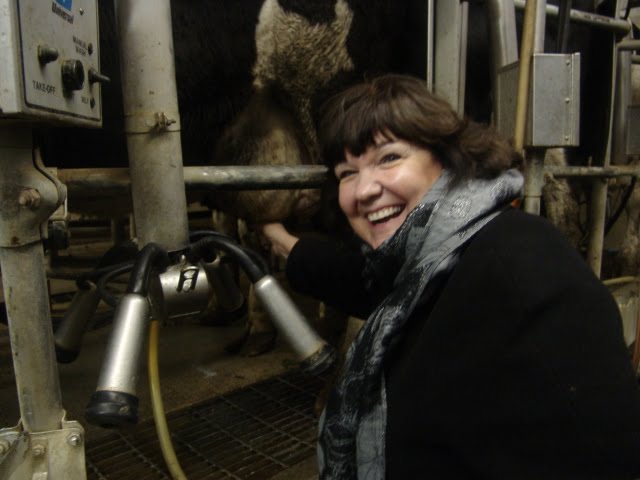
SATURDAY, JANUARY 8 - From this entry’s title, you might be able to guess where we were headed next: yes, a working dairy. Considered small by dairy standards, the King Brothers Dairy Farm has 70 Holstein cows which are milked twice a day. The family-run multi-faceted operation also includes a number of angus cattle to be eventually sold for meat and acreage for raising crops as well. Our purpose in visiting was to see the dairy end of things, and so after fussing over several adorable three and four day old calves, we watched the real action take place. Ten massive Holsteins at a time were led into the milking bay, where they were hooked up to the vacuum milking device that monitors the milk flow and automatically stops when the flow slows so as not to harm the animal. The milk travels into a pump which then sends it to a refrigerated tank in the next room, where the product is rapidly chilled and held until it is picked up by a tanker truck every couple of days.
Kaila made many friends of the bovine variety by promising, "I'm not going to eat you!"
Mr. King and his sons were extremely gracious and open, inviting us into the milking bay to try our hand, literally, at the process itself, each of us getting a taste of what it was like to milk a cow the old-fashioned way.
Got milk, Kadi?
And speaking of getting a taste… Mr. King at last poured for us from the holding tank a cup full of the freshest milk any of us ever had; as we each drank from the cup, we shared a moment that was beautifully Eucharistic, a communion between ourselves, the animal, the land, and indeed the Divine spirit that is in with, and under it all.
Okay, maybe it wasn’t quite all that… truth be told, it weirded me out a little. But it was good milk, and it was without a doubt a special moment.
And finally, like the – ahem - “overly eager” altar guild member, Kaila happily consumed the remainder of the cup with no objections from the crew. Grateful for the day but increasingly wearied, we piled back into the van for the return trip to the church and on to dinner with our host families. Salúd!
SATURDAY, JANUARY 8 - Following lunch we made our first trip to the town proper of Albion (population approx. 1200), the center axis of our entire journey and the home of Zion Lutheran Church, where Pastor Mike is the assistant pastor (not to be confused with Immanuel-Zion, mentioned earlier). Our first stop was at the Boone County Historical Museum, closed for the winter but opened especially for our group (but not heated for our group – it might have been colder inside than outside). Warmed by his encyclopedic knowledge, local historian Paul Hosford appeared unaffected by the frosty conditions and regaled us with fascinating stories about the Native American tribes from the area, the early European settlers, and several aspects of Albion’s changing social and technological conventions over the decades.
Alpha hasn't found a keyboard yet on this trip that he can't resist, even at the museum.
Lorin inquires about what's for dinner in the museum's kitchen display.
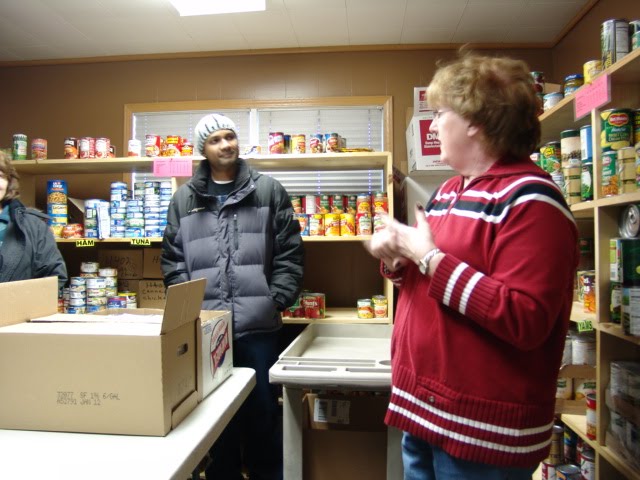
Then it was back into the Mystery Machine for a visit to the Boone County food pantry, impressively well-stocked and skillfully organized and managed by the enthusiastic Nancy Krohn, who explained to us the magnificent support the pantry receives from the churches of the community as it serves the needy of greater Albion (below). May God grant them continued success!
Some days on this trip are bound to be so packed with activities that limiting their description to a single blog entry will prove impossible.
This was the first of those days.
We began by breakfasting with our host families, who then delivered us to Immanuel-Zion Church where Pastor Mike showed us a very comprehensive and helpful episode of “Modern Marvels” that was all about corn: how it’s grown and harvested; the difference between sweet corn that we eat as kernels and “dent” corn that is processed for just about everything else, from ethanol to plastic to corn flakes cereal; what genetic modification has meant to modern corn production; and the debate over high fructose corn syrup. Present at the viewing were Paul and Jeryl Kettelson, corn and soybean farmers who are members at Immanuel-Zion. The Kettelsons shared their thoughts and experiences related to farming and in contrast with the video, giving a real human voice to the challenges and realities of modern farming.
Soon we standing on the very land the Kettelsons own and farm, listening to Paul explain their methods of irrigation that keep nearly every drop of water on their land and prevent any runoff that would remove the valuable topsoil, observing the remnants of the corn and soybean harvest, and getting up close and personal with the Kettelson’s machinery, their combine and tractors. They treated us to a splendid lunch in their beautiful home while we heard tell tales about the county fair and the history of the Immanuel-Zion congregation.
Above: Paul Kettelson (in red coat) explains the basics of water, soil and planting to the students in the middle of a corn/soybean field.
The immensity of one of the Kettelson's tractors is evident!
And it was cold. Really cold. Just take my word for it. I won’t say more about the cold right now, because if the weather predictions are correct, you’ll be reading plenty more about the cold next week… there’s a cold snap coming that is worthy of writing home about. Brrrrr.
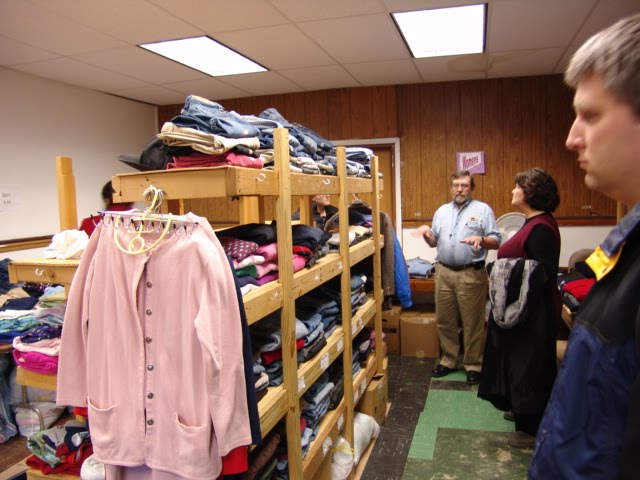
After the late departure from Chicago and a bumpy ride into Omaha, our spiritual treasure hunting expedition arrived to Nebraska delayed but undaunted. We were greeted by our host pastor, Mike Kern, as well as fellow synod pastors Ruth Boettcher and Gretchen Ritola, who treated us to an abbreviated lunch at the airport (the engine problem in Chicago cost us what surely would have been a splendid meal at the Spaghetti Works). Lorin then took the keys and subsequent command of the 2011 version of the Immersionmobile (a 12-passenger van), and we headed for the base of operations for Lutheran Metropolitan Ministries, an organization sponsored by the Nebraska synod that operates a food pantry and provides clothing/basic personal supplies in one of Omaha’s neediest areas. Pastor Damon Laaker (right, in background) and food pantry operator Lori Lindberg gave us a tour and explained the center’s operation, before we met the administrative assistant, Francine, whose deep faith and unfettered joy brought smiles of admiration and inspiration to all of us. In these people and their wonderful ministry, we had indeed discovered spiritual treasure worth savoring.
Francine's smile lit up our day!
Boarding the van, we followed Pastor Mike for the two and a half hour trip past seasonally-bare crop fields, farm machinery dealers, and several tiny towns, then along progressively less smooth and more remote country roads to reach Immanuel Zion Lutheran Church, which emerged as a beacon from the pitch darkness of the countryside. Warm light poured through the stained glass of the sanctuary into the cold, giving us a glimpse of the fullness of nourishment and hospitality that awaited us inside. The members of Pastor Mike’s main congregation had prepared a magnificent spread (below), which they had generously refrained from partaking of until we arrived, even considering our tardiness. We enjoyed great food and conversation with the dozens who had gathered to greet and feed us. Exhausted but satiated, we travelers then separated into pairs and were chauffeured by our host families to our places for the night.
Before retiring, I stood outside and looked up into the night sky for some time. I marveled at the unencumbered view, at the ring of the Milky Way visible to me for the first time in many years. The number of stars was breathtaking. It was indeed a multitude of the heavenly host, precious gems sparkling as brilliantly as had the faces of our “heavenly hosts” who welcomed us with such kindness and grace. Thanks be to God.
In the gospel reading for Epiphany read in chapel yesterday, we heard the story of the magi who follow a Star westward to an unfamiliar land, bringing with them precious gifts for the Christ child.
We prepare to board our plane, and like the magi we also follow a star - our daystar, the sun - as it makes its trek westward toward a land that is unfamiliar to us. As our journey unfolds, where will we encounter the Christ child? In whom will we perceive the Light of Life? What gifts do we bring to honor him? May the Spirit grant us eyes to see, ears to hear, and hands to feel.
Three Wise People: Lorin, Becca, and Kaila “gaze expectantly” towards the Star before heading west... after an hour and a half delay.
Whoever entitled this blog “Adventures in Rural Immersion” was a wise person indeed – for we are definitely in for an adventure.
My six traveling companions (including our intrepid and enthusiastic leader, Kadi Billman) and I have spent the past two days in class at LSTC getting a crash-course on the great state of Nebraska and rural ministry in general from Pastor Brenda Pfeifly of Salem Lutheran Church in Stromsburg, NE and farmer/rancher Kent Miller of Sidney, NE. These classes follow our reading of three assigned books about various aspects of rural ministry: Dynamics of Small Town Ministry (Lawrence Farris); Sustaining Heart in the Heartland: Exploring Rural Spirituality (Miriam Brown); and Rural Evangelism: Catching the Vision (Mark Ruffcorn). In the midst of heartfelt conversation throughout this second day, we gathered around the Lord’s Table for Epiphany Eucharist, after lunch shared a delicious dessert, celebrated dinner at Cedar's courtesy of the Nebraska Synod, and overall enjoyed the initial jelling of our resolute group of spiritual treasure seekers.
Kadi Billman, Patricia McClean, Pr. Brenda Pfeifly (front), Kaila Hochhalter, Lorin Kirksey, Becca Ajer, Kent Miller (front), & Alpha Sabbithi enjoying amazing dutch apple pie in honor of Patricia’s birthday tomorrow. Not pictured: Yours Truly.
For most of us in the group, this trip represents a journey into a culture and way of life that we have been exposed to only sporadically at most. Also, with almost 70% of the ELCA’s congregations being in rural/small town settings, there is a good possibility that all or most of us studying for ordained ministry will find ourselves in such a context for first call. That makes this present adventure also a glimpse into a possible future. For these reasons at least, I’m sure there are varying degrees of apprehension and anticipation present in all of us; at the same time however, as a group we are excited to witness the incarnation of that which we have been reading and learning about.
For me personally, this will be a new adventure in an additional way: I have never “blogged” before. An earlier blogger here was advised to, “keep the entries short” (not starting off so well there, am I?). With practice on my end and patience from our followers, I don’t expect my lack of blogging experience to have a negative effect on the trip. What may actually have a negative effect is my being a University of Tennessee football fan and still just slightly bitter about the results of the 1998 Orange Bowl (final score: Tennessee: 17, Nebraska: Waaay more than that). Being that Cornhusker football is the religion of Nebraska, I promise to bear this cross with grace!
Despite the comments some of us received from family members and friends over the Christmas break when we mentioned our plans for J-term – “Nebraska in January? Eeewww!” – we are all genuinely looking forward to this opportunity to learn more about Nebraska, its famously kind and generous residents, rural ministry, and yes, more about ourselves. Thank you for joining us. We are honored by your presence.
Now, where’s my Indiana Jones fedora? Shoot – back home in St. Louis. Sigh. Anyway…
It's been just over a week since we returned from Nebraska. Looking back, I now have some perspective on what an incredible trip it was. I'm amazed at how many places we visited and how many people we met in just nine days! I'm incredibly thankful that I had this opportunity to experience rural life, even if it was just for a few days. My life has been enriched by the people and land of Nebraska.
This trip wouldn't have been possible without the generous support and hospitality of the Nebraska Synod and the countless pastors and lay people that we encountered. I can't begin to say "thank you" enough for hosting us in your homes and churches and taking the time to show us around your beautiful region of the country. Not only did you make this trip possible, YOU are what make this trip so special year after year.
Although the title of my post says "farewell," I may pop up here again in the near future to share people's final projects with you. My classmates did some fantastic work, from writing academic papers to constructing devotionals and Bible studies. I hope that I can share these with you at some point.
I've assembled a photo album of our trip to Nebraska. It includes many additional photos not yet posted on the blog, so I hope that you'll check it out.
Thanks so much for taking the time to read along during this journey. I hope that you enjoyed reading it as much as I enjoyed writing it. Remember that this blog is updated every year, so check back next January for another blogging adventure, same bat-time, same bat-channel.
Part of my classmates' work for this course is to comment on the blog, providing three thoughtful responses that add to the overall conversation. I hope that you'll take the time to look at the comments, as they provide a lot of great details and insights. Thanks to my classmates for their helpful additions!
These videos are brought to you courtesy of Pastor Bob Bryan, our host pastor during the rural immersion. The videos show many aspects of rural life throughout the year, such as the beautiful landscape, the harvest, the county fair, and the winter weather. Thanks, Pastor Bob!
We made the newspaper! No, we're not featured in the New York Times, but we did make the front page of the Yankton Press & Dakotan. A journalist came to Hartington to interview us last week while we had lunch at the senior center. Check it out...a few of us are quoted.
FYI, I've uploaded some videos in previous posts for your viewing pleasure. In the post entitled "Social Ministry in Nebraska," I've included a personal greeting from Bishop deFreese of the Nebraska Synod. I've also included videos of the cattle auction in the post entitled "Cows Cows and More Cows."
Our host church, Trinity Lutheran in Hartington, organized a rural ministry workshop today entitled “Rural Ministry: What’s Working?”. In attendance were members of the Nebraska Synod Rural Ministry Taskforce; local pastors, both Lutheran and from other denominations; and lay people. It was a neat way to cap off our immersion, bringing together much of what we had learned. We heard presentations from Martin Kleinschmit, whose organic farm we visited on our first day in Hartington, and Charles Shapiro, a professor of Soil Science and Crop Nutrition at the University of Nebraska—Lincoln. We were also able to attend small group sessions on various aspects of rural ministry, such as stewardship and programming.
It was fun to spend the evening with Teens for Christ, the youth group at Trinity, as they had a lock-in at the church. No, we didn’t stay up all night with them because we have a plane to catch tomorrow, but we did stay until 9pm. The event was run in part by a group of college students from Augustana College in Sioux Falls. They helped to organize activities, worship, and bible studies for the teens. They brought a lot of great energy to the event. I guess that their energy was infectious, as I turned into a stone-cold competitor during a game of “Slide Your Bum,” according to Carmen. Who knew I had a competitive edge? We also finished off our week-long marbling with an awesome potluck. This was a true Lutheran potluck, my friends. Check out that awesome spread of crock pots in the kitchen, as well as all the desserts.
We take off tomorrow morning for Omaha where we’ll catch a flight back to Chicago. Although our time in Nebraska is nearly finished, we’ll be reconvening this Wednesday and Thursday for further processing and debriefing of the experience. We’ll be sharing our final projects with each other. We’ll also be joined by our host pastor, Bob Bryan, as well as Pastor Brenda Pfeifly, who came to Chicago before the trip to prepare us for the experience. Stay tuned later this week for more updates on the interesting projects that people are putting together. I’m also in the process of assembling some great videos for you guys to watch from our trip, as well as a photo album of our time in Nebraska.
We started the day with a jaunt out to a wind farm. Nebraska is fertile ground for harvesting energy from wind, and many companies have begun to invest in this technology. This particular wind farm is situated along a ridge where the wind is almost always blowing. It’s difficult to understand just how big these wind turbines are from the pictures, but the distance from the end of one blade to the end of another blade is 100 yards. Pretty amazing!
We made a quick pit stop in the town of Lindy. The town officially has a whopping population of 14 people, but there are really only eight people who live there, according to the town’s Lutheran pastor, Kelly Pedersen.
We visted Pastor Kelly’s church, Good Shepherd, which recently added on to its sanctuary and fellowship hall. The church even raises its own cattle. Last year, the church raised 50 cows, making a profit of $10,000! Whoever said that all rural churches are dying or lacking innovative forms of ministry needs to see some of the churches that we’ve encountered on this trip.
We had a great time attending a cattle auction in the town of Verdigre. More so than ever before, our attempts to blend in with the locals were foiled. We joked that everybody turned their heads, including the cows, to look at us when we entered. I’m not sure what it was, but I think that Sally’s rainbow scarf gave us away.
Here's a little video of the cattle as they are being prepared for the auction. The sounds and the smell were intense as I prepared this video. Unfortunately (or maybe fortunately), I wasn't able to bring you the smell, but you can at least hear how loud it was out in the yard with thousands of cattle.
And here's a little snippet of the auction in progress.
We received a wonderful tour from the owner of a local feedlot, the home of 7500 head of cattle being fattened up for eventual slaughter. The owner of H&H Cattle gave us great insights into the meat industry. In a previous post, I mentioned the debate regarding whether cows should be grass-fed or grain-fed. The owner made a good point that, as long as we demand beef on a year-round basis, we have no option but to raise cows on a diet consisting primarily of grain. There is simply no grass for the cows to graze from September to May, so unless we change our demand for beef, it will be difficult to eliminate corn and other grains.
We also had the chance to step aboard a John Deere tractor. Talk about rolling in style! This thing is fully enclosed with A/C.
BTW, check out this picture from the feedlot. It's an interesting juxtaposition to see this huge mound of distiller's grain, the byproduct of ethanol, a controversial source of energy, against a backdrop of wind turbines, another emerging and controversial source of energy.
We ended the day by attending a high school basketball game in the town of Wausa. Sports are an integral part of the culture in rural towns, providing activities for the youth and a social venue for the people to gather. The women’s varsity team pulled off an exciting win against Coleridge, once again the home of our very own, Phil Hefner.
It’s interesting how certain events sometimes converge in a very meaningful way. Before we had even arrived in Nebraska, we had planned to spend today in Norfolk learning about different social ministries that are available. Our schedule included trips to the Norfolk Rescue Mission, Kids against Hunger, and the Orphan Grain Train. For years, the latter two organizations have provided food, clothing, and other resources to impoverished communities and nations throughout the world, including Haiti. On Tuesday, the earthquake in Haiti hit, devastating the island nation. Little did we know when our itinerary was put together that we would have the opportunity to contribute to the relief effort.
We packaged up boxes of food for the people of Haiti at Kids against Hunger. The organization packages a nutrient-dense meal of rice, vegetables, soy, and chicken flavor. In less than an hour, we were able to prepare enough food to feed over 1700 people. The food that they send provides essential nutrients that the people often lack in their diet. Malnutrition and starvation are common occurrences in Haiti but are more widespread than ever since the earthquake. Food is often so scarce that people resort to eating cookies made out of dirt. Read this article to learn a little bit more about "mud cookies" and food shortages in Haiti:
http://www.msnbc.msn.com/id/22902512 (Sorry that the link doesn't work. Just copy and paste it into your address bar.)
We were also able to box up shipments of clothes at Orphan Grain Train:
We all wish to extend our prayers to the family and friends of Ben Larson, a seminarian at Wartburg Theological Seminary, who was killed in the deadly quake. We’ve been receiving email updates for the last couple of days detailing the unfolding situation in Haiti, and while we rejoice for the many people who have survived the earthquake, our hearts grieve for the families and friends of Ben and the countless others who have perished. Merciful Creator, your Holy Spirit intercedes for us even when we do not know how to pray. Send your Spirit now to comfort us in these days of need and loss, and help us to commend all who have died to your merciful care; through Jesus Christ, our savior and Lord. Amen.
We ended the day with a delightful supper with the bishop of the Nebraska Synod, the Rev. Dr. David defreese. We heard about different opportunities for ministry in the Nebraska Synod, and Bishop deFreese was kind enough to field our anxious questions about candidacy and the assignment process. Hey, it’s not every day that you have an audience with a bishop. All in all, it was a fitting end to a very meaningful day.
Bishop deFreese kindly shared a personal greeting with our little team of Nebraska adventurers and all those who are following our travels online.
We journeyed north of Nebraska today into Yankton, South Dakota, just across the Missouri River. Yankton is the home of Tom Brokaw. I learned today that television stations used to seek out broadcasters from the central plains region around Nebraska because the people were deemed to have the plainest, least noticeable accent of any region in the country. Johnny Carson grew up in nearby Norfolk, Nebraska, whose residents also exhibit the same accent.
Although it was closed for the season, we were able to tour the Gavin’s Point Dam. The dam regulates the flow of water on the Missouri River and is an important source of energy for the local area. The dam formed Lewis and Clark Lake, an important area of recreation for the region. The trees which line the river are a popular place for bald eagles to nest. I saw my first bald eagle ever. For your blogging enjoyment, I attempted to snap a photo, but the eagle spread its majestic wings and soared away before I could get a shot. We also visited the Lewis and Clark visitor center. This region was an important stopping point on Lewis and Clark’s expedition, where the explorers made contact with the Sioux nation.
We enjoyed lunch at the Hartington Senior Center with many local residents. We also met with the Hartington Economic Development team. They outlined a broad vision of where they see Hartington moving in the future. They envision Hartington as an affordable place to run a business and a safe, nurturing community to raise a family. A theme that we consistently here from all the locals is that the people make Hartington a special place. The locals appreciate that everybody in the town knows each other and are able to support each other in both good times and bad times.
We got our first real break of the trip this afternoon and were able to just wander around downtown Hartington. We visited some local shops and enjoyed the relatively warmer weather. It’s funny…after only being here for four days, people are already recognizing us as we walk around town. Even people that we had never met asked us if we were the group visiting from Chicago. Now I understand how everybody knows everybody in a small town. It was great to get out today and just decompress after a very intense schedule the last few days. We have certainly been immersed in the local community with all that we’ve been doing. Many of us were very tired and had been trying to catch some ZZZs whenever we could, especially on bus rides between locations.
Remember that picture of all of us sitting on the bus? We’ve been trucking around the last few days in that very bus unable to figure out how to properly work the heater. The first few days we didn’t know how to turn off the heater. It felt like a sauna in there. Then somehow the heater got turned off and we drove around for a couple of days with no heat. It was so cold in the bus that we actually brought blankets with us. Today, we finally figured out how to control the heat by flipping a nondescript, inconspicuous switch somewhere on the front panel. Praise the Lord! Now we’re traveling in style!
Today was a very important day for all of us. We began the day by meeting with the people of Our Savior Lutheran Church in Dakota City. This church supports an Asian ministry which ministers to the large Asian population in Siouxland. Many Asians immigrated to this area as far back as the time when the transcontinental railroad was being constructed and continue to immigrate today to take entry-level jobs in meatpacking and other similar industries. The Asian ministry is led by Pastor Soriya Roeun, who fled Cambodia as a refugee in the 1970s. Pastor Soriya also works as a chaplain at the Tyson Foods plant in Dakota City. Tyson Foods normally does not grant tours to outside groups, but Soriya was able to secure a tour for us. Although he was able to gain access for us, cameras and other electronic media were strictly prohibited, so I’m unable to share any photos with you.
We were all struck by the sheer volume and enormity of the meatpacking operation. The plant employs 3800 people. Every day, 4884 cows are slaughtered and packaged for delivery to stores. Except for the actual moment of death, which is performed by driving a metal spike into the cow’s brain followed by the slicing of the cow’s jugular artery, we were able to witness nearly all aspects of the slaughtering process. The process is very methodical, using hooks, conveyers, chutes, ETC. to move the cows from one end of the plant to another. As the cows move along, they become progressively smaller and smaller, becoming the cuts of beef with which we’re familiar. This mechanized process is assisted by the 3800 employees, who slice and dice with knives and incredibly sharp cutting tools which I’ve never seen before in my life.
We reflected upon the experience throughout the day, and we all concluded that it was very sobering to watch the process. Although the overconsumption of meat in the North American diet poses humanitarian concerns, overall I’m not ethically opposed to the killing of animals for food; at the same time, watching this highly mechanized process made me realize how removed I am from the sources of my food. The industrialization of food has created a disconnect between the animal and the end consumer. When all we have to do is go to a store and by a package of meat, we forget that the meat was once part of a living, breathing creature, whose life was taken for our sustenance. When we no longer have to kill our own food, we lose sight of the fact that that the taking of another life, even animal life, is a profound event, a moment not to be taken lightly. The experience at the meatpacking plant made me yearn for a deeper connection to the earth and all its creatures, one in which I am more intimately involved with the sources of my food.
 Patricia takes a ride on the wild side.
  Kaila gets instructions so she doesn't get the four-wheeler stuck in the snow.
  Becca is all smiles, despite getting the four-wheeler stuck in the snow.
 Patricia, Kaila, Becca and Alpha couldn't gush enough about the great "off day" they had.