Saturday, January 12, 2008

Day One

From Ted Kooser's Local Wonders: Seasons in the Bohemian Alps (Lincoln, NE: University of Nebraska Press, 2002):

"Contrary to what out-of-state tourists might tell you, Nebraska isn't flat but slightly tilted, like a long church-basement table with legs on one end not perfectly snapped in place - not quite enough of a slant for the tuna-and-potato chip casseroles to slide off into the Missouri River. The high end is closest the Rockies, and the entire state is made up of gravel, sand, and silt that ran off the front range over millions of years."

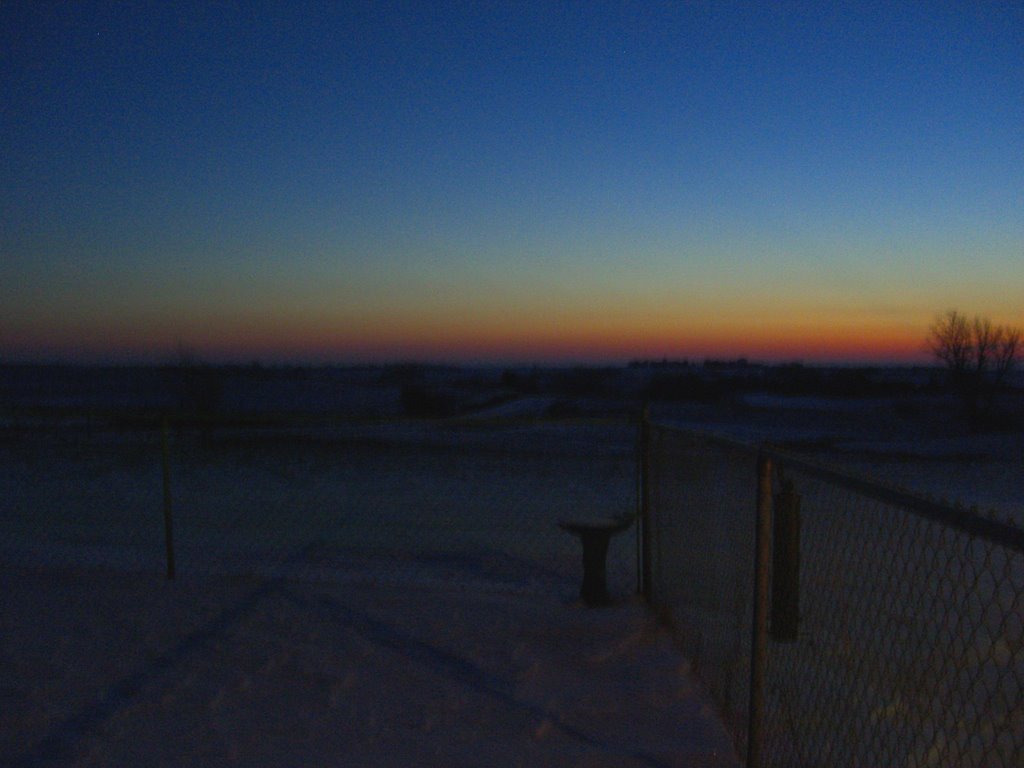
This morning our hardy group of six Rural Adventurers, one LSTC professor, and two rural immersion leaders flew to the Rocky Mountains and then drove to Kooser's "high end" of the Nebraska table. It strikes me that the word "Nebraska" is actually kind of shaped like the state - not as it looks on the map but as it might look if you turned it on its side and looked at the high plains of the "N" down to the Missouri River that ends the "a"....in any case, I nodded off on our way out of the city, and awoke to find us driving through wide-open plains. Adam marveled at the expansiveness, to which Dennis, the native Nebraskan accompanying us, responded, "Yeah. You know, you really gotta be at peace with yourself to live out here." As he said this I turned toward the front of the car and watched as we headed down a small hill. At the bottom of the hill the plains seemed to stretch out forever under one of the clearest, bluest, biggest skies I've ever seen. I gazed at what Nebraskan writer Lisa Knopp calls "the seam where sky and land meet." I don't know about having to be at peace - I imagine God still finds ways to wrestle modern-day Jacobs on the banks of the Platte River just as much as on the banks of the Jabbock - but there is certainly a spirit of stillness out here. This is the kind of place where Psalm 8 fits the landscape like a glove:

"When I look at your heavens, the work of your fingers,
The moon and the stars that you have established;
What are human beings that you are mindful of them,
Mortals that you care for them?

Yet you have made them a little lower than angels,
And crowned them with glory and honor.
You have given them dominion over the works of Your hands,
You have put all things under their feet,
All sheep and oxen,
And also the beasts of the field,
The birds of the air, and the fish of the sea,
Whatever passes along the paths of the seas." (vv.3-8, NRSV)


Later we stopped at Cabela's, a massive outdoor sporting goods store. You can find Cabela's all around the United States now, but Cabela's impacts few places the way it impacts Sidney, Nebraska. Cabela's is based here. I didn't fully appreciate this fact until my host family picked me up and gave me a driving tour of the town. Some of the churches were making large, beautiful additions to their buildings. I wondered aloud whether these churches were growing because the town was also growing? "Well," said my host, "Cabela's keeps bringing in more and more people - see that building over there? That's another one of their new corporate offices..."

Of course, it's not all due to Cabela's. The Spirit has been moving in wondrous ways too, and her effects are in full view in the new gathering space of Holy Trinity Lutheran Church, where we'll be based here in Sidney. This entryway is comfortable, spacious, and inviting; it seems to encourage you to stay awhile. It's a place to nurture old relationships at the church and a place to start new ones. It's evidence of flourishing, God-given life here, and the people of Holy Trinity are justly proud of it.


It's also evidence of the many changes at at Holy Trinity in the last several years, changes, I've learned, that have not always been easy even as they've made the place breathe with new life. Tomorrow we'll attend an annual conference on rural ministry and learn about the changing face of rural ministry from pastors and lay people who are doing God's work out on the plains.

For now, though, I need sleep. I hope I'll dream about that wide-open sky, and lose myself in that "seam where the sky and land meet."

MCK

Friday, January 11, 2008

At the Airport

Greetings! I’m Matt Keadle, and I’ll be blogging the 2008 J-term Rural Immersion Class. If you scroll below this post, you can see blog postings from last year’s class. If you scroll above, you can see future postings from me, or maybe, depending on when you’re reading this, postings from some future class that doesn’t even exist yet.

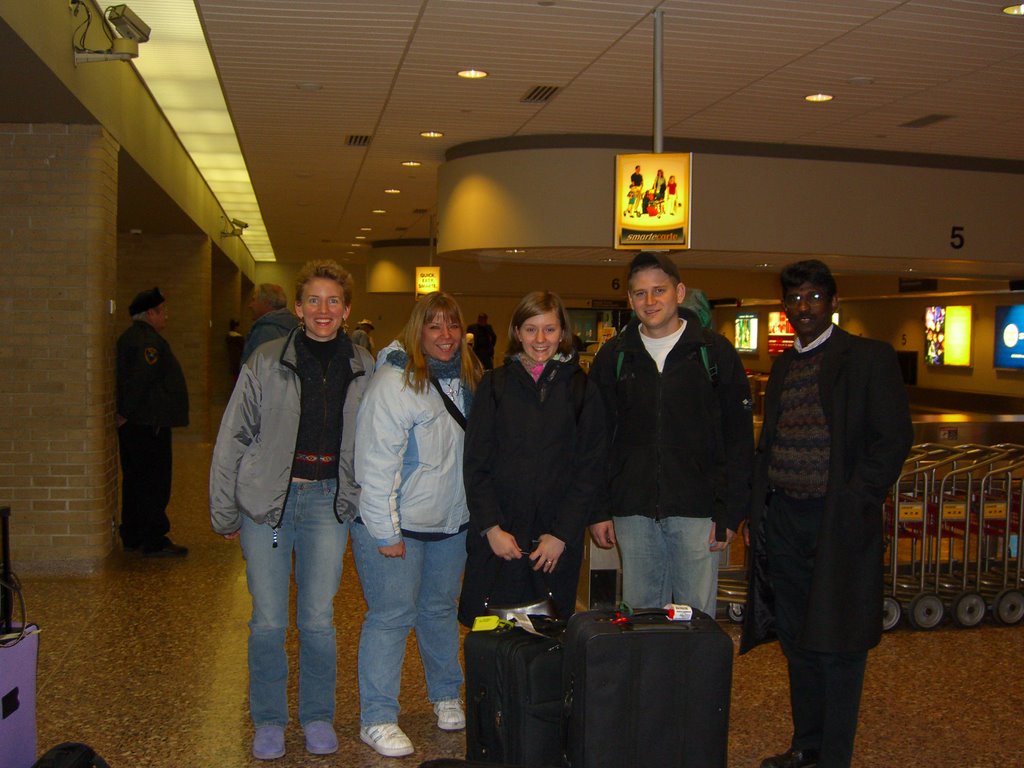
I’m writing this first post from Chicago’s Midway airport, about a 40 minute bus ride from the LSTC campus. In about 90 minutes we’ll be departing for Denver, Colorado, and then we’ll make the drive over to Sidney, Nebraska, where we’ll be staying this year. Here’s a picture of Adam, a fellow Rural Immersion adventurer, and I at Midway airport.


For the last two days we’ve heard about rural life from Rev. Ruth Boettcher, a pastor in rural Nebraska, and Dr. Dennis Gengenbach, a Nebraskan ag producer. It’s been a helpful window into what we’ll be encountering in the coming days. We’ve heard about the challenges Dennis and his fellow ag producers face as they seek to grow food and fuel for the rest of the country (and other countries, too). I have pages and pages of notes and lots of thoughts which are impossible to include here. But in short: Agriculture, we’ve learned, is a highly dynamic field that has changed dramatically in the last few decades, presenting difficult challenges as well as deep joys for its practitioners and their families. We’ve also learned a bit about how rural churches are being revitalized as they have rediscovered anew the gospel of grace for all of God’s people. And I’m sure there will be much more to come soon.

I work at an after-school program when I’m not blogging, and one of the students yesterday was giving me advice about blogging. He also has his own blog. He’s in second grade. He said, “Matt, let me give you a helpful tip. Keep your posts short.” Then he proceeded to give me another helpful tip, which amounted to Googling a fancy program that tracks the number of hits you get on your blog. Did I mention he’s in second grade? Anyway, for now I’ll stick to the first piece of advice and keep it (relatively) short.

Besides, Adam asked me to watch his bag. Hmm, I should probably make sure it’s still there…

Matt

Friday, January 26, 2007

The End of the Line

Like all good things, J-term too comes to an end, and that end is now. From here on out, all of our ruminations about our time in Nebraska are for us to ponder in our hearts, not in public, as we continue our journey through seminary. To all of the wonderful people that we were fortunate enough to meet during our trip; thank you for your hospitality and your patience. You welcomed us into your homes and lives and we were lucky to have you. Thank you to everyone who took the time to read what we wrote here. We appreciate it and hope that you got something out of it. We certainly did.

Good night sweet blog, and flights of angels sing thee to thy rest.

Thursday, January 25, 2007

Mea Culpa

While stuffing my laptop into its carrying case for use in class presentations today, I quickly removed some papers that were hanging about in the case. My eye caught on one of the papers and I realized that it was something that I had promised to scan and upload to the blog awhile ago, and that I had failed to do so. So without further ado, here it is.


This artwork is from the cover of a bulletin from Followers of Christ Church. The church is led by Pastor William Barth and is located in the Nebraska State Penitentiary. The design was created by one of the congregants and is shown here with the permission of Pastor Barth.

Vitality

There are seven principles, or practices, defined in Discovering Hope, by David Poling-Goldenne and L. Shannon Jung. They are:
Prayer
Worship
Discipleship
Evangelism
Servanthood/Ministry
Leadership
Understanding Context
The final practice, Understanding Context, was the purpose of my last post. Therefore, I will not consider it here. However, I will spend some time reflecting on St. Matthew (and what I know about St. John), rural ministry, and these practices.

Prayer: Prayer is a primary practice among vital churches in all settings. In my worship class this past semester, my professor, Dr. Mark Bangert, suggested that we are the best answer to our prayers. Our prayers cause us to act. In all honesty, I did not see a lot of thoughtful prayer on this trip. I do not mean that as a criticism, but as a statement of fact. I ate a meal of leftovers one night and someone said "It's already been prayed over." Or, during the prayers of intercession, even in examples of worship services given to us at a conference, they were listed as coming from a worship resource instead of being written to suit the needs of the community. Lots of churches do that, but what are they loosing when they do so? Why isn't prayer a common practice? What effect is it having on the ministry in these areas? I am very curious to see a church with a strong prayer practice. Discovering Hope is full of examples, but I would really like to know how they practically work. What does a strong prayer ministry entail? How does a church decide what to focus on in its prayer ministry? What would be unique about that in a rural setting?

Worship: By far, the most exciting worship I went to on this trip was the worship at the Rural Ministry Conference on our second Saturday in Nebraska. It was geared toward our purpose. I also attended a workshop there on worship. It was taught by Pr. Nancy Nyland whose former congregation is outlined in Discovering Hope. She provided us with several examples of worship services she had done over the years. While I may not be brave enough to do the services in my own church, the strongest key to them was the fact that they were written for certain groups on specific days. For example, she had written a liturgy for Rogation Sunday, to commemorate the time for planting. Both Nancy and the book seem to emphasis doing things differently and creatively. However (and perhaps those things are a part of this), I think that vital worship is planned to suit the needs of the community while remaining open to newcomers. That does mean that it is important to create a level of comfort for worshippers. As Nancy pointed out, there does need to be some level of predictability, such as a familiar order to things. I think that if the congregation is comfortable with the worship service, they will be able to be more available to help visitors, they can participate with greater energy, and they can become more attune to the meaning of what is happening. I am not a proponent of doing things the same way every time, but, rather, or being aware of a congregation's needs and listening to them.

Discipleship: Discovering Hope thinks that learning is at the center of discipleship. They point out the importance of "Bible study and devotional reflection" (46). I never attended a Bible study at St. Matthew, but Marianna, my host mom, spoke glowingly of the Bible studies she attended. This does seem key. At the Rural ministry Conference, creative and thoughtful education through Sunday School and Confirmation ministries was the topic of two workshops. These things give congregants the tools to share with others what they have learned. Discovering Hope calls this "Disciples mak[ing] disciples" (47). I worry, however, that Bible studies may not be attended or at times readily available to everyone in the church body. More can be done to model behavior. Prs. Amalia and Eric at Long Branch Lutheran talked at length about how they struggled to model hospitality, leadership, and even family devotions for their congregation. Making disciples is not an easy task. One thing I thought that was frequently missing was the training of lay leaders to also participate in this modeling behavior.

Evangelism: I have a sneaking suspicion that what I have to say here will cause the greatest knee-jerk reaction among those who hosted us throughout our journey. While I am sure evangelism is happening among Nebraska's rural churches, I didn't see it on any explicit terms. These churches do do service, which puts their name out there, but I saw very little done to focus on bringing in new people. There seems to be an understanding that everyone knows the church is there, and anyone who wants to come, can. At the Rural Ministry Conference we talked about the importance of relationships in rural congregations (those of us on the trips really felt that this is a staple in ALL congregations) (I also think it is worth noting that "evangelism" was not mentioned, nor was it a "what's working workshop" topic). The congregations we met were pretty good at establishing relationships, but, at Salem, one member commented that even after several years she had still felt like an "outsider." The speaker at the Rural Ministry Conference talked about the importance of being people-centered instead of program-centered. I totally agree, but programs (ie, service projects, childcare, leadership retreats, bible studies, Sunday School, Confirmation - are these all not "programs") have a place in evangelism. They are places to invite people. They are places to encourage members to engage their neighbors. They are places were people can be on the same playing field, reducing the insider-outsider feel. I am not sure that I have the right answer, but I certainly feel that I still have a lot to learn about how successful evangelism works in rural areas.

Servanthood/ministry: Servanthood was something I saw everywhere I went in Johnson. People gladly giving up their time to help others. The rescue squad and fire department are volunteers! People whose children are grown are religiously at the basketball games to support the teams. Every church we went to made quilts for Lutheran World Relief. However, it seems that the churches limit their own ministries because they know of the many things their members already do. What effect does this have on the church members? What if they are not involved in these community service projects? What do they do then? Discovering Hope points out that these caring ministries must be oriented to the needs of the community in order to be successful and/or vital. I am not sure that I am able to answer the question I'm going to ask, but: what ministries might be started at St. Matthew/St. John to help meet the needs of the community?

Leadership: Here is a place where I saw some vitality. I met several strong pastors who are cornerstones of the community. I saw pastors who attempt to model the godly life for their congregants. Moreover, I met amazing lay leaders with genuine hopes and dreams for their congregation. They were storehouses of information, waiting to be taped. I think vital rural ministry will look inward at itself for ideas that can be used outward. I don't mean that they will be centered with themselves, but that it will listen to the needs expressed by their members. This is an excellent place to start when looking for ways to jump start any of the above ministries. This is where I saw the most success in Nebraska. First, look at all the leaders who were willing to host our group. We met people at the Sunday service who had stories to tell about what they had seen and are seeing happening in their areas. Many of the places we toured we places of employment for members of the area churches. They are the frontline of evangelists, whether or not they know it! The ladies went to Salem Lutheran and met lay leaders who were thoughtful and aware what was going on in their community, what was good at their church, and the places they were lacking. They were thoughtfully pondering where to go from where they are now. At the Rural Ministry Conference, there were many pastors, but there were just as many lay leaders. They had great ideas!


It may seems as though I am being harsh here. That is not my intent. Every congregation has room for improvement. As a non-member and an outsider, I am able to look more objectively at what is going on. On the other hand, I know that I am unaware of the full scope of a congregation's ministry. A good portion of my comments, I hope, will serve me well when I have my own congregation. I think the greatest key to ministry, in any of the areas above, is careful discernment of God's call. He is the most aware of the entire situation and can guide us in ways we never imagined.

Wednesday, January 24, 2007

Trade Offs

Anywhere one lives, there are bound to be some good points and some bad points. It's a thought that keeps on coming back to me since we left Nebraska. Be it Chicago vs. Nebraska or just rural vs non-rural, what's the trade, what are some of the strong points of each and some of the weak points? Everyone will value certain things differently, so I can't say how it would all stack up according to someone else. All I know is what are the factors that strike me.

Yesterday I was downtown, making my way to the nearest stop for the #6 Jackson Park Express bus, when I was stopped and ordered to proceed through six lanes of traffic and use the sidewalk on the other side of the street. This was because they were filming Fred Claus. (see the trailer here) right outside of Nordstrom there and had commandeered the whole area. This is where people value things differently. Some would be thrilled. Maybe they would get to see Vince Vaughn, Paul Giamatti or somebody else. Me? I was mostly just annoyed at having to cross traffic.

There are a lot of things like that. A city has certain amenities, but each person values them differently. I enjoy the shopping. As for sports, I am at best, indifferent. I have a sneaking fondness for things like opera and ballet, but not the resources to support such interests, so it makes little difference. I enjoy museums and the variety of restaurants, but rarely eat out. The public transportation is great, because I prefer not to deal with the traffic and parking here. However, it has its limits. I can't carry heavy furniture home with me on the el and people consider things to be so easily available in Chicago that they aren't very helpful about my need to be able to get the furniture somewhere. Whereas, when something is considered to be a rarer commodity locally, people are sometimes more helpful. (I've known someone to take a furniture shopping list composed by family, friends, and co-workers, buy the stuff and then drive it more than 2,250 miles to its destination, since they were going that way anyway.) Sometimes when I'm walking alone after dark, I wonder how much of the need for constant vigilance I would be happy to trade for sidewalks that rolled up shortly after six. So how do you feel about pollution obscuring the stars or a lack of options for your Friday night entertainment? Those are decisions that we all need to think about and be prepared to make when the time comes.

Reflecting

There are a few things I would like to do to reflect on my rural immersion. First, I would like to use Johnson and St. Matthew and St. John as a kind of case study of rural life. Thus, I will consider what I learned about Johnson, as Lawrence Farris suggest in Dynamics of Small Town Ministry. Then, I will consider how St. Matthew compares to the principles of vital church ministry established in Discovering Hope.

In his book, Farris suggests that a new pastor do a few things to get to know the community one is entering. He suggests that understanding the town's dynamics will help one understand the people. Farris outlines five areas one should investigate: area geography, town geography, town history, town culture, and town values. Farris also suggests why these things are important. I would like to consider each area independently by outlining the things I noticed during my short stay in Johnson and by asking any remaining questions I have.

Area Geography: Several of the books we read cite R. Alex Sim who, in his book, Land and Community, outlined four types of small towns: Ribbonvilles, Agravilles, Mighthavebeenvilles, and Fairviews. The names say a lot about them. After visiting Johnson, I think Johnson is a Mighthavebeenville. Truly, it is a great place, but if Johnson's residents need to do shopping or be entertained, they drive 15 minutes to nearby Auburn, which is an Agraville. Farris suggests that Mighthavebeenvilles are controlled by and dependent on the nearby Agraville, as seems to be the case in Johnson.

The area about Johnson is hilly (here is Johnson, its location in Nebraska, and its relief). From a high hill, one can see neighbors in all directions. Sometimes tall trees get in the way. Many houses use evergreen trees on the north and west sides to help protect them from the wind in winter. Most of the surrounding area is farmland. The people here seem very close-knit. My host mother could point out each house and tell me volumes about who lived there. I think the fact that they can see one another so easily leads to this open feeling.

Some remaining questions: What is the year-round weather like? How does that effect this area? What does the area look like at other times of the year? How does that effect people?

Town Geography: Johnson has a main street. On main street, there is a small grocery store, a gas station called "The Quick Stop" (though that name does not appear on the building), the fire station, the grain elevator (where the picture at left is taken), the meat processing plant (Wednesday is slaughtering day), the cafe, the tavern, the bank, the small funeral home, the insurance company, and the school. St. Matthew and the local Methodist church are two blocks west of the main drag. There is also a baseball diamond on the west side of town. One can see the remains of a lumber yard. Some of the business are boarded up.

The sidewalks roll up early in town, probably around dark. They cafe is open for lunch after church on Sunday. It has a buffet. There are no francaise stores. Other than the Cafe and the White Horse (the bar) there are no other restaurants. The signs pointing to the town talk about the famous chicken barbecue

Remaining questions: What was this town like in its heyday? What were the businesses that are now closed? What is the town like during the chicken barbecue? Who comes?

Town History: I was unable to glean much about the town's history. It seems to be very involved in agriculture. I did glean some recent history. For example, across the street from St. Matthew is a Habitat for Humanity House. Unfortunately, the family had some troubles, so the status of the home is unclear. The meat processing store used to be owned by Augie and Lois, the family Peter stayed with.

Remaining questions: What is the town's history? What were have been Johnson's defining moments? When did businesses start to close? Have the businesses there always been the same? What about the churches? When did they come in? Who founded them?

Town Culture: Farris outlines six things to consider about an area's culture: economy, politics, social life, education, and cycle of events. Johnson's economy is agricultural. The grain elevator seems to the hub of what's going on in town. According to the US Census Bureau, the two other major employers of people living in Johnson are education and "Transportation, warehousing, and Utilities." I was not able to tell much about the political situation in Johnson. I think it is worth noting that the rescue squad and fire department consists entirely of civilian volunteers. The social fabric of Johnson is complex. Of course, there is the chicken barbecue. There also are people who are regulars in the cafe and the White Horse. Education is extremely important in Johnson. The students had access to laptops. The teachers were very dedicated. Nebraska has open enrollment. Students DO come from other districts to Johnson. The offer a very quality education in their K-12 school. Finally, the cycle of events. The chicken barbecue is part of the cycle. Being an agriculture society, planting, harvest, and calving all, inevitably have to do with this cycle.

Remaining questions: What is the political situation in Johnson? What trend is being seen in the local economy? Why is education so important in this community? What are other important events in the town's year?

Town values: Farris, again, suggests four key values: community, longevity, place, and forbearance. Community was key in Johnson. One night the ladies of our group got together at my host mother's house to watch a chick flick. Marianna and I offered to take Joy home. On the way, we got lost. We couldn't find Joy's hosts' house. It became the talk of the day the next day because Marianna should have known where Mary (Joy's host mother) lived. Being a longstanding member of this community means being aware of where others live and what is going on in their lives. For example, one couple clips the crosswords from the newspaper for Marianna. If she's not there one week, it is assumed that she is with her daughters in Kansas (she normally lets Pr. Catherine know where she's going). If she were gone for more than a week, they would get concerned. That is very important to this community. Longevity is also important. Much of this is displayed in how things are described. Instead of being "the white house with green shutters" it is "So-and-so's Old House." So-and-so might have lived in the house three owners before, but that doesn't stop the locals from using their names to describe the landmark. Another example is the importance of the cemetery fund. Many of the pastors we spoke with told us of the untouchable, massive cemetery fund, used to care for a church's cemetery even after the church was gone - how's that for longevity? The idea of place as a value has something to do with being good stewards of the earth. It also has something to do with maintaining the town's existence. Johnson might be a good example of this because, despite of growing town nearby, the residents still exercise loyalty to their local businesses. They know the potential collapse that may result if they search outside of Johnson for things. They understand the consequences of their actions. Forbearance. I could go on and on about this topic. The loyalty I talked about above is one example of the community's forbearance. Another example might be the Habitat House. Or, the involvement of all the churches in Lutheran World Relief quilting projects. Or, the presence of community members at basketball games. And surely, the untold stories of generosity towards others.

Remaining questions: What would a resident list as Johnson's key values? What might they add to my list?

Monday, January 22, 2007

Unrepentant Laziness

Ahhh. Back to Chicago and nothing I have to do right now. I went, bought groceries and came back to my apartment which features a supply of down comforters (really, I own three) and a stack of library books that aren't due yet. I think I'll just hole up here and relax from all of the excitement of Nebraska, not emerging until it's time for people to do their presentations about the trip. But until that day (Thursday and Friday) comes, I think I'll just sit around, processing my experiences/watching television (that, and going "wow", I forgot how small house lots are in Chicago). If I have any deep thoughts in the mean time, I'll be sure to let you know. But if any do occur, I'm quite sure it won't be before noon. Until then - sweet dreams and I'm off to the land of fluffy blankets.

Home Again, Home Again, Jiggity Jig

Okay, maybe a cheezy saying - it's very common in my family. I imagine my parents are smiling as they read it.

I wanted to let our readers know that we are home. We had a nice evening last night - we watched both the Bears and Colts win from the large screen T.V. Zach is watching in Joy's picture, below (the T.V. is not in the picture). We really enjoyed the camp's hospitality center (dubbed "the land of milk and honey"). We had a quiet night. On the trip to the airport, I tried to get carsick, but I'm fine now. Our flight was great.

I'm glad to be home.

I really wanted to write to tell you, dear reader, to keep reading! If you have a chance, check us out on Friday. By that time, I know I will have posted a sumation bit about my impressions of the trip and what I learned. See you then!

Sunday, January 21, 2007

I Corinthians

This morning our professor led us in worship (LBW setting one, no communion). There was no sermon, but we were supposed to sit there, meditate on the gospel for the day (from Luke, Jesus reading in the temple) and share our thoughts on it. However, my attention was caught, not by the passage from Luke, but by the second reading, from I Corinthians Chapter 12. It’s a very well known passage, with Paul talking about how the body of Christ is composed of many parts.

Something about the whole J-term experience this year made it strike me especially powerfully today. It struck me on a couple of different levels. The first level involved the different personalities on this trip. On most issues raised in the group, I am on one side of an issue and my classmates are on the other side. We get all excited and our professor wisely moves us on to another topic. Now I, of course, always believe that I am right, and am more than willing to defend my views. Not only do issues relating to religion tend to be rather important to me (I mean, one would hope that they are important to a master of divinity student.), but many have been formed by hard experience which is not easily ignored or discarded. However, most of the time, my classmates disagree with me. Issues of religion are no less important to them and based on the passion with which they talk about their experiences, they have obviously also had important experiences which have led them to different conclusions. We are very different people and will make different sorts of ministers. However, as different and contradictory as what we do and what we seek may seem, it doesn’t mean that any of us will be less useful. The body of Christ is composed of many different parts and we will serve somewhat different parts in different circumstances, because no two congregations are identical.

On another level, people connect to God in different ways and it is always a struggle to get the various ways to see that the various ways are equally valid. One person will feel closest to God when striving to bring God’s justice in the world. Another will feel closest when surrounded by others singing “Shine Jesus Shine”. A third may feel closest when deep in silent contemplation in a monastery. Yet another may feel closest to God when reading a lengthy treatise on theology. They are all very different ways of seeking relationship with God, yet they can all bring about the desired result. The problem comes when looking from our own path to God, we see that another person’s path has none of the same guideposts as ours, and so we assume that their path cannot be truly leading to God. One pastor once described God as a giant barn where God’s presence can be found in every inch of it. Our lives and our experiences of God are like a baseball that we get one chance to throw at that barn. That ball’s trajectory comes into contact with the barn and maybe even the space inside, but only a small portion of it. The reality of God is so immense that we can’t wrap our minds around it. Another person’s path and interpretation of what they’ve passed through may not intersect with ours at all, but that does not mean that they are not experiencing God.

Churches are like that too. They experience and express God in a number of different ways, but most importantly, they are all experiencing God. Different churches, of different sizes and different locations serve differently, but they all serve the same One. Some churches are about the excellence of their choirs and some are about the closeness of their communities, but all have the same goal of drawing people closer to God. Be it an urban church or a rural church, all are necessary to the body of Christ. There are different ways to serve God and different places to do so, but what is essential is that we serve God. Who knows what part of the body of Christ we will be in at the end of our four years at LSTC and whether or not it is a part that we would have picked. What we need to do is trust that God is putting us where God needs us.

There are different kinds of gifts, but the same Spirit. There are different kinds of service, but the same Lord. There are different kinds of working, but the same God works all of them in all men. (I Cor 12:4-6)

But in fact God has arranged the parts of the body, every one of them, just as he wanted them to be. If they were all one part, where would the body be? As it is, there are many parts, but one body. (I Cor 12:18-20)

Now you are the body of Christ, and each one of you is a part of it. (I Cor 12:27)

(above quotes taken from the NIV)

Walking in a Winter Wonderland

OK, they were right. The scenery here is pretty as a picture. So . . .


pretty scenery


more pretty scenery


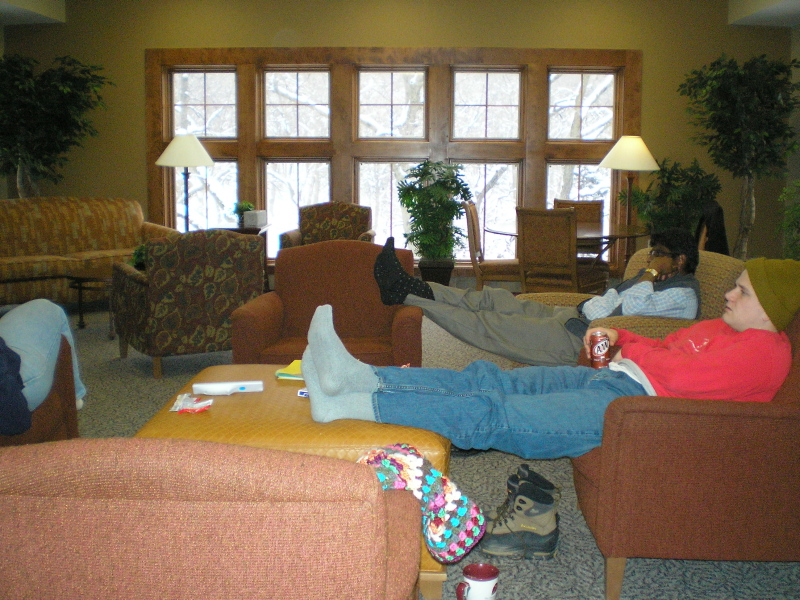
the Swanson Center aka "The Promised Land" to me and my classmates - It is right down the road from where we spent the night and it is fully stocked with comfy chairs, a giant television to watch the Chicago Bears play, a multitude of beverages and most any snack available. It's amazing.


Enjoying the promised land (featuring Zach and our professor, Peter V.)

Saturday, January 20, 2007

You Might be a Rural Pastor if . . .

OK, let's try this again, and hope it sticks this time, because it's after midnight, and I just lost my whole entry when my newly updated Internet Explorer decided to start blocking stuff. Grrr . . .

Addrianne and I spent the night at Pastor Barbara's parsonage because it had internet access (very useful when doing a blog) and it was closer to the conference that we were going to today. This morning she gave us enough copies of Salem Lutheran's cookbook for our whole group and drove us to Aurora for the conference.

After arriving, we signed in, got name tags, and were fed coffee and donuts. The conference was kicked off with worship, which I quite enjoyed. (I'm not sure if it's due to their dedication to the subject at hand or a matter of most of them having voices that are vastly superior to mine (Sorry, future congregation!), but groups made up of clergy and dedicated lay people always seem to do a beautiful job of hymns.)

The keynote was given by Pastor Steve Tjarks. I enjoyed listening to him. He was an engaging speaker and made several interesting points.

1) Unlike business, the success of a church isn't about quantity, but quality. It's not about how many people you can get in the door, but the quality of the spiritual life there.

2) Rural ministry is all about programs, but about relationship. A rural pastor doesn't succeed by offering all the latest, greatest programs, but by loving and being in relationship with the congregation. A congregation can sense if you love them or are just putting your three years in before going on to something bigger and better.

3) More and more people who are coming to rural ministry are not from rural backgrounds. They feel frustrated and isolated by things and ways of being that they don't understand. Their rural congregations need to be very intentional about making them less isolated (invite them over for the holidays, introduce their kids to other kids their age in the community) and explaining things to them. Their families are also fish out of water, and you need to help them too if you want the pastor and their family to stay. An example: a new pastor came home and couldn't find his family, who had been unpacking when he left. He eventually found them huddled under blankets in a corner of the basement, trembling in fear, because they had mistaken the local lunch whistle for a tornado warning.

He made other interesting points, but I'm too tired to remember them without my notes right now, so you'll just have to trust me on that one. However, I did enjoy, and received his permission to reproduce here, his signs that you might be a rural minister.

The following section is copied straight from a presentation given by Pastor Steve Tjarks at the Nebraska Rural Ministry Task Force Rural Ministry Workshop at Messiah Lutheran Church in Aurora, Nebraska on 1/20/06.

If you are a clergy-person, here are the top 10 signs that you might be a rural pastor.

10) All meetings start later in the summer than in the winter.
9) Poisoning the ground squirrels inhabiting church property poses no moral dilemma for any church council member.*
8) You live on a gravel road, and it's better than many paved roads in the area.
7) Your closest neighbors are accurately termed "livestock".
6) Your church doors are never locked, and no one knows where the keys might be.
5) It is assumed that riding in a combine with one of your members is "real ministry."
4) The parsonage has always been, and will always be, white; both inside and out.
3) The local coffee shop sells gas, oil, tires, livestock feed, ag chemicals, and fertilizer; and the coffee is free. Drinking coffee in this location is considered legitimate ministry.
2) The church cemetery has at least one former pastor buried in it.
1) Your members' stock trailers have never been cleaner than the day they moved you into the parsonage.

Then we had a chance to talk to Bishop David deFreese, head of the Nebraska Synod, over lunch, which included cherry cobbler with vanilla ice cream for dessert. (All I can say is that if hospitality can be measured by the desire to feed one's guests, Nebraska must be trying to set the gold standard.) All of the pastors we've talked to while we've been here keep saying good things about him, and it's easy to see why, with his personable manner and good listening skills. He asked us about rural immersion, what worked, what didn't (even taking notes) and listened to our answers. He also talked a bit about rural ministry, emphasizing how, especially in the rural church, it's all about relationship.

After that we attended two sessions of our choice. I (and Adrianne) chose to attend sessions on Ministry with the Aging and then one on Worship. They were interesting, but at this point, I've hit the trifecta of tired, cranky and unable to remember what I'm writing about, so I had better wrap this up.

When the conference was over, we got into the car to try to race the snow to our next destination, and the sky was as white as the ground.


We arrived at our destination, the Carol Joy Holling Center, without incident. This center, located in Ashland, is the headquarters of Nebraska Lutheran Outdoor Ministries. It's supposed to be beautiful here, but with the cold and the darkness, I am yet to verify this (but I can verify the existence of chocolate almond tart).

Anyway, if this publishes successfully, instead of disappearing, I'm off to bed. I can leave the important things like lounging around and admiring nature from a comfy chair for tomorrow.

*This reminds me of the one of my favorites, the Lutheran squirrel joke. Have you heard it?

There were four country churches in a small Texas town: the Presbyterian church, the Baptist church, the Lutheran church, and the Catholic church. Each church was overrun with pesky squirrels.

One day, the Presbyterian Church called a meeting to decide what to do about the squirrels. After much prayer and consideration they determined that the squirrels were predestined to be there and they shouldn't interfere with God's divine will.

In the Baptist church, the squirrels had taken up habitation in the baptistry. The deacons met and decided to put a cover on the baptistry and drown the squirrels in it. The squirrels escaped somehow and there were twice as many there the next week.

The Catholic church got together and decided that they were not in a position to harm any of God's creation. So, they humanely trapped the squirrels and set them free a few miles outside of town. Three days later, the squirrels were back.

But the Lutheran church came up with the best and most effective solution. They baptized the squirrels and registered them as members of the church. Now they only see them on Christmas and Easter.

Just a Few Notes

The capitol building in Nebraska was very interesting looking, so of course I took pictures. Here is the building's dome . . .


. . . As viewed under the power of a persuasive guide.


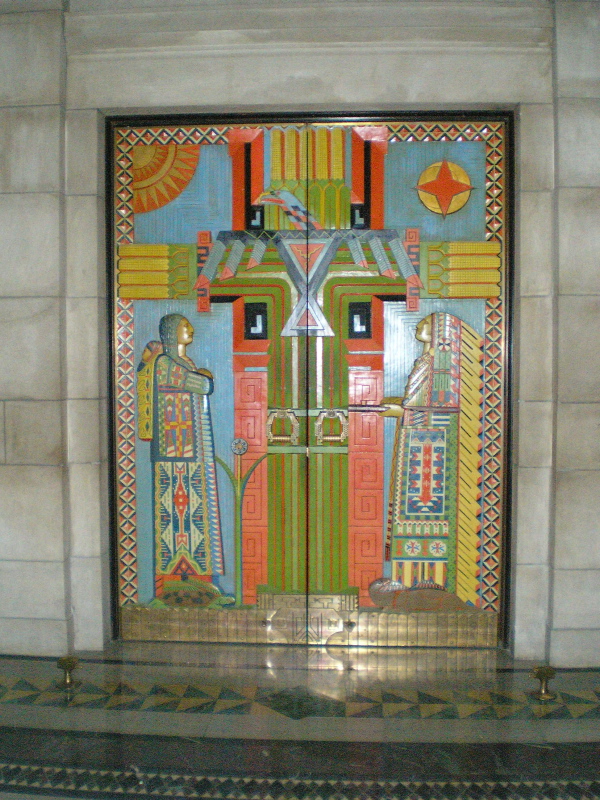
Prior to the tour, I was aware that Nebraska has a unicameral legistlature. However, I had assumed that it started out that way. Today I found out I was wrong. It started out as a bicameral system. It was changed, at least in part, thanks to the efforts of George Norris. Here is the door to the legistlative body that is no more.


. . . And the door handle in detail.


Two rather famous Nebraskans are Father Flanagan (founder of Boys Town) and Willa Cather (author of works such as O Pioneers! and, my personal favorite, Death Comes for the Archbishop).

Later in the day, as Adrianne said, we met up with Pastor Barbara and we got to talk to members of her church. At that conversion, she not only gave us a lot to think about (and I do agree with Adrianne that the boys missed out), but a lot to eat as well (hot tea and two kinds of coffee cake style breads). We talked about the problems and decline that can be found in rural churches, but it was the kind of conversation that one leaves feeling energized, rather than drained. So, all in all, it was a good end to a good day.

P.S. Pastor Barbara also recommends Open Secrets, so it's not just me.

Friday, January 19, 2007

You Just Have to Love 'Em


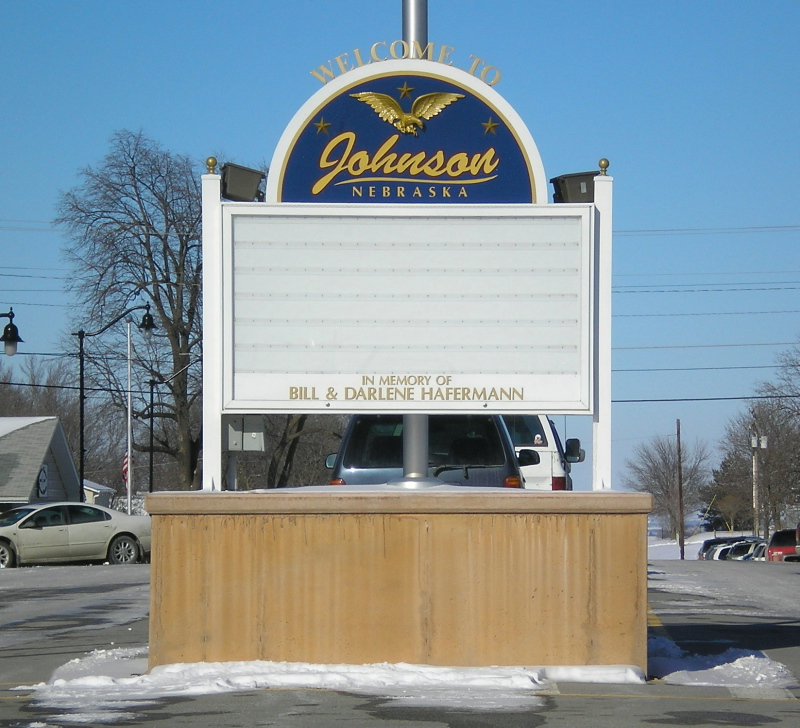
Today was an eventful day. For the ladies, it was our final day in Johnson. So, on our way out of town, we pulled over for our favorite Johnson landmark - the sign. Apparently, Johnson has the fabulous barbecue every year. Maybe we'll be back in the future to experience it.

We met Pr. Brenda in Palmyra before heading to Lincoln (the capital!!). Pr. Brenda was praying to open today's legislative session. We toured the capitol building. It is absolutely beautiful. It is covered in art and has gorgeous architecture. It is very tall = 14 stories! Nebraska, unlike the federal government and every other state government, has an unicameral government. That means they only have one house in their legislative branch. It has 49 seats, elected by district (instead of county, of which there are 93). 13 total seats belong to the metropolises (Lincoln and Omaha), all the rest are representatives from rural areas. To conclude our tour, we prayed with the senators and went through half of their agenda (it was a short day), and took our leave.

Next we went to University of Nebraska -Lincoln (UNL). We had lunch with Lutheran Campus ministries there. The program is fairly successful and well known. We met their four peer ministers. The new pastor, Fritz, had a lot to say about what he saw as being a successful campus minister.

Then we went to Region V Services, a group which provides mental health and substance abuse services in 16 counties of Southeast Nebraska. We learned about Emergency Protective Custody, in which police are permitted to place a person who could be a danger to themselves or others in custody and take them to a crisis center. Region V Services has started a program which attempts to lesson the amount of EPCs necessary, by responding to the situation, assessing an individual needs, and attempting to create a safe environment while providing necessary services.

We met with Pr. Barbara, who we met when we first landed, she took us gals back to her home stomping grounds. She lives about 12 miles from the Kansas boarder in South-central Nebraska. I fell asleep in the car and woke to find we had left the gentle rolling hills of the east to the flat-as-a-pancake plains of the central region. We had dinner at the local bar (which is basically the only place to eat out around here). Then Barbara had arranged for us to meet with some of her parishioners. We met with four couples, all long-term members. It was very interesting to talk with them. We talked about trends in the church, especially in regards to attendance and pastoral care. We talked about what was working, what had them excited: they said they were excited about the way their congregation was like family. We also talked about what was troubling them. The were really concerned that parents were not attending church, nor requiring their children to do so past confirmation age. Moreover, the children are so very busy with extra-curricular activities that coming to church has slipped to a very low position on the priority list. We mused about what could be done. The couples were very receptive of us as we talked about our impressions and theories about what we saw in rural ministry. We talked about the "lack of boldness", as Trish put it, that we viewed among rural parishes. We felt that churches who were vital were being risky. They had strong programs, such as bible studies and prayer ministries which encouraged faith. They were intentional about their hospitality and their forming of community.

As we talked, the one thing that kept passing through my head was something that I had heard several times this week. All any parishioner wants from their pastor, and perhaps from each other (and I might venture to guess that this expands beyond the rural communities) is love. Pr. Barth, from the prison, mentioned that when he spoke of a former call. He asked the call committee in his interview, "What do you want from me?" They responded, "We just want you to love us, Pastor." It was clear from the response of the congregates at Salem Lutheran (Barbara's church) that this is what they desired and what they were concerned wasn't being produced at seminary. I guess that this is a question that the church must grapple with: how do we let people - all people - know that they are loved, both by God and the community of believers?

Thursday, January 18, 2007

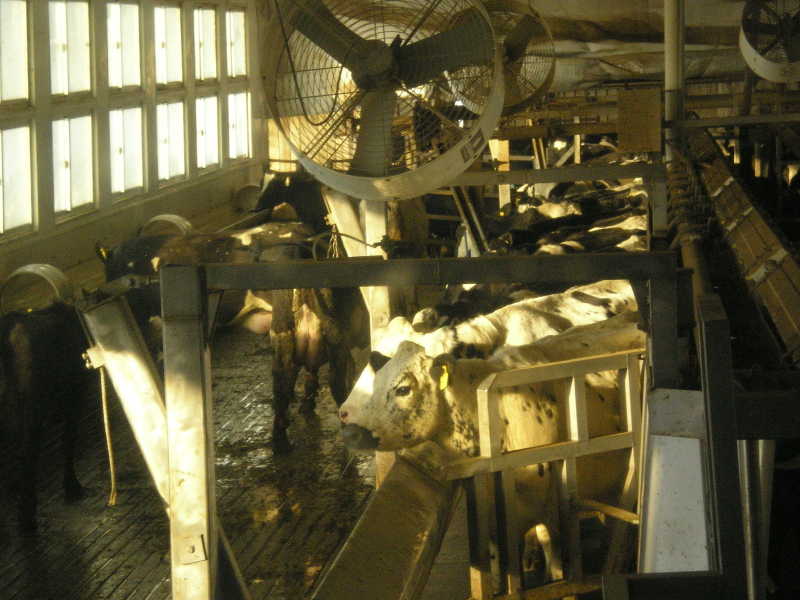
Of Milk and Parlors


Any idea what the above photo is a picture of? (And no, cows will not cut it as an answer.) It is a picture showing part of a milk parlor. What the heck is a milk parlor? It's where the cows go to get milked. While those cows are standing there, they are being milked by automatic milking machines. There are two rows of cows being milked and between them is a much lower central aisle where workers run around collecting the milk. OK, maybe you felt no pressing need to know that, but I felt a pressing need to tell you, because until today if someone had said "milk parlor" to me, I would have envisioned something very different. In fact, the first image that ran through my mind when I heard those words was of a sort of cafe for elderly British ladies who thought tea was too hardcore. As you now know, I was quite entirely wrong.

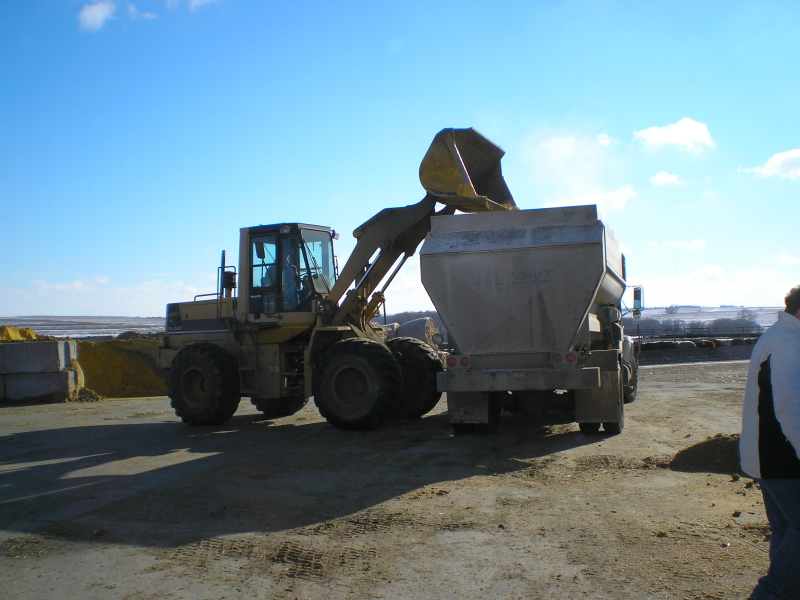
One thing that amazed me today was the vast quantity of feed that a feed lot goes through. I would have thought that I had a clue, seeing as I lived down the street from a feed lot for four years, but I was honestly astonished at the amount of feed they use. Here is a picture of food being mixed for the second feeding of the day and it's not enough to feed all of the beef cattle at the operation either. All I have to say is that's just a whole lot of feed.


Finally, and perhaps most importantly, this is Henry, the feed lot rooster, because, well, doesn't every feed lot need a rooster to pamper?

Full-Chicken Body Scan

Hello, reader! Sorry I've missed you the last couple of days, they have been long and busy. The last two nights have been straight to bed once I returned home. It has been cold and windy, which take a lot out of a person. Joy has done a great job of updating you on the last few days. As I reflect on them, I have learned a little bit about pastoral care in a rural areas. In many ways, it is not very different from ministry in other contexts. However, one must take into account the mindset of the congregants one serves and the local and regional context. We alsso have discussed the importance of intentional community in rural areas. We have noted that less "vital" churches (as Discovering Hope calls them) are programs of the community. In contrast, vital churches create programs for the community. Of course, "for" means that these programs are methods by which the church bears the good news to the community. However, those programs may take on a variety of different looks. St. Matthew, St. John, and Long Branch all sew quilts for Lutheran World Relief, which is one example of such a program. Long Branch has also been making strides to become more hospitable, as another example.

Now, to today's activities and, eventually, the event that named today's post.

Today was farm day. We started with an hour long drive to Palmyra to meet Pr. Brenda. She lead us to Praireland Dairy near Firth, Nebraska. There, we got to see how they milk cows. They are set up to milk 120 cows per hour. They milk each cow three times a day!

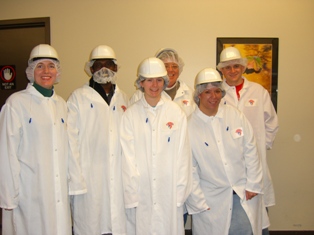
After the dairy farm, we went to the Smart Chicken Processing Plant. We doned hairnets, frocks, earplugs, and hard hats to see how a full, freshly plucked chicken becomes the various parts or gets tied up for oven roasting. The chickens come to the plant in Waverly from another plant outside of Tecumsah (where, Pr. Brenda was told, they do the "sacrficing"). They look very similar to a chicken one might put in their oven for a special dinner. People hang them by their feet onto two miles of chain. The chickens fly around the plant. Every chicken as the very tips of their wings cut off by machine. They are scanned, by computer, to maintain only perfect chickens for whole chickens, everything else is dropped at various times to be cut by people. From the control station, one can see a picture of each individual chicken. The computer images has lines pointing to flaws. Sometimes they are not obvious, such as skin imperfections, and sometimes they are, such a missing wings. Our guide told us that the missing wing probably was a wing that was broken in transport, which cannot be used. The scraps and "inedibles" are taken to be made into dog food. Smart Chicken is unique because it is "air chilled," a process that allows the birds to be frozen without using extra water.

Then, we went to the Feedlot. There, cows are "finished." That means they are fed a diet which we cause them to gain the most weight, going from 700 pounds to 1200 pounds in 150 (or so) days. They had lots of black angus cows. They host 1600 cows at a time. Each cow eats 40 pounds of feed a day (I think that's the right number).

We we able to enjoy old-fashioned ice cream sodas at an old-fashioned drug store in Springfield, near the feed lot.

We ended our evening by bowling. My best game? 86. I'm a terrible bowler. Zach bowled the best game - apparently a personal best - at 150. I also owned the worst game with 27. Told you I was terrible.

Tonight is our last night in Johnson. I hope to write tomorrow to tell you about our time in Lincoln, the capital of Nebraska. Until then, God's Blessings!

Wednesday, January 17, 2007

In Which No One Complains that There's Not Enough to Do

We did a lot today, like most days here. Just in case some of us were harboring hopes of a quiet J-term of rural relaxation on LSTC's time, those illusions should certainly be gone. The Nebraska Synod takes this immersion business seriously.

Today we toured a funeral home and talked with the funeral director. The outfit seemed very well run and professional. I was surprised to find out that it's a one man operation. That one man took time out to talk to us about the business, what he does and how the pastor fits into the picture. (I really liked the cookies that he fed us too. The chocolate chip ones were especially yummy.)

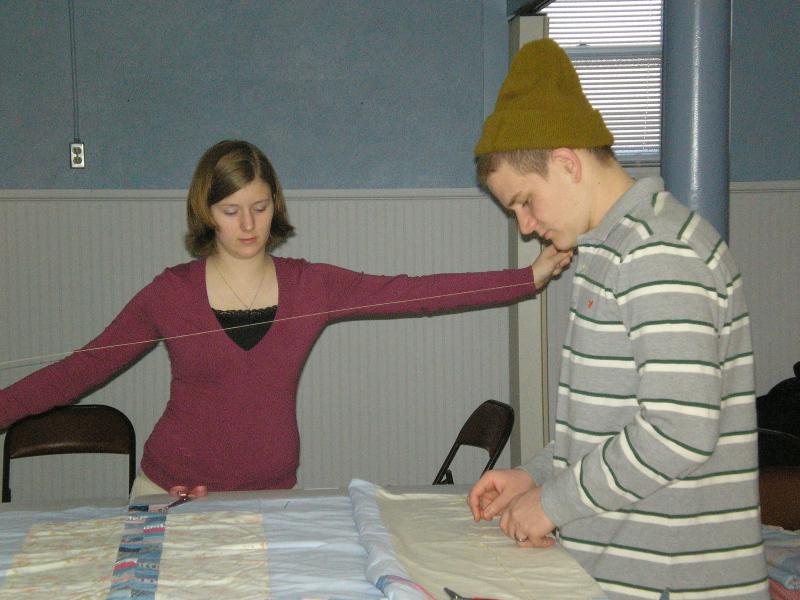
After that we went back to St. Matthew's and not only were able to see the ladies in action at their Wednesday quilting group, but had a chance to get in on the action.


Featured above are Adrianne (yes, the other contributor to this blog) and Zach, another one of our classmates, showing off their mad skills.

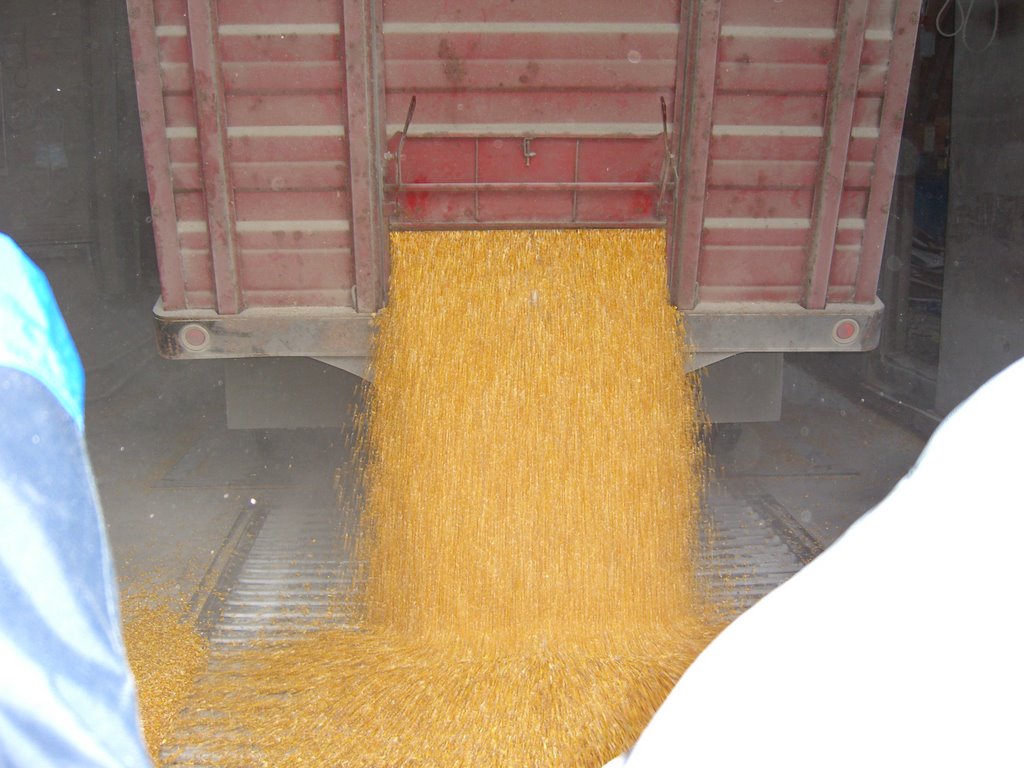
Next we toured the local hospital and our host pastor in Johnson, Pastor Catherine, told us how they work out chaplaincy for the hospital, because there is no hospital chaplain. She also talked about her work with the rescue squad, which is entirely volunteer (much like the local fire department). Then we headed over to Good Sam's, the local assisted living facility, and immediately sat down for lunch. We toured the facility, talked with staff, sat in on bingo, and stayed for coffee time (And yes, there were snacks, why do you ask?) Our final tour of the day was of the local grain elevators. The trip taught me that there's a sort of conveyer belt, covered in little metal buckets that scoop up grain, which goes straight up and dumps the grain when it gets to the top.

After a break, relaxing and playing cards, I joined the males of our group (Zach and our professor, Peter V.) in observing Pastor Catherine's confirmation class (which had three students). However, before the class ended, I had to leave and join the other females in going to observe the confirmation class at Long Branch (which has 13 kids in its program). During confirmation, they made sure that we didn't starve with pizza and goodies. The confirmands did skits and tried to answer the question of who Jesus is. When confirmation ended,we were allowed to wander around the church and discovered that behind the altar, they have a large cross lit with pink neon. It's not what I was expecting to find in rural Nebraska, that's for sure. I suppose it just goes to show some of the assumptions I make, conscious or not.

Tuesday, January 16, 2007

This is the Good Life

We have been spending most of our days in Johnson, Nebraska, and it seems like time that you, dear reader, got to know a little more about the place. (Here are two websites with detailed information of the kind that you're not going to get from me in this blog.) Some of the area's biggest employers are the nuclear power plant and the prison, neither of which are located in Johnson itself. It has a very friendly small town flavor. Doors are never locked and you will likely find car keys sitting in unlocked cars. (Even their approach to the possibility of prison escapees has that sort of flavor. One strategy is to leave the car unlocked, the keys in the ignition and a candy bar in the front seat. In other words, all an escaped prisoner would want to do is get out of such a small town where everyone knows each other, so just make sure that there's no reason for your paths to cross during their attempted flight.) This is a town that loves to feed people (as my waistline would happily attest to) and very much sees itself as a community. If your house burns down and you don't have insurance, up springs a drive for old furniture and a rental is found that you can stay in for a while without worrying about rent. For the population, there's a fair number of churches in the area, most of which are Lutheran. Some of the churches (Lutheran and Methodist) have combined their Sunday schools to make sure that despite their small size, they can continue to offer it to their youth.

Here's what you first see when you enter Johnson, Nebraska.


. . . And as you get closer . . .


Tonight we saw some basketball games at the high school, boys' and girls' varsity teams. The junior varsity teams also played earlier, but we missed those games because we were busy being fed by the ladies of St. Matthew's. (They were only feeding a total of nine people, including themselves, but it was the sort of meal where they put four sticks of butter on the table, just in case we were feeling a wee mite peckish.) Both of the teams won their games to the hearty approval of the sizable crowd that showed up to support them.


In such a small town, where they have their own school, all of the grades are housed together, K through 12. However, they had some things that really surprised me, in one of their media oriented classes, all of the students were playing around on laptops, they have a class where students work on designing an electric car (they currently have two cars in progress) and in keeping with the Johnson lifestyle, none of the lockers have locks.

Earlier in the day though, we had visited one place where the no locks rule most definitely did not apply, the state prison. We also got to meet with a pastor who is the guy to talk to about things like prison chaplaincy. He was actually called by the Nebraska synod to work with a congregation that is inside the walls of the state prison in Lincoln.It strikes me as something that could be a very challenging ministry, but a challenge that Pastor Barth is up to. I think the man has skills. (There's a bulletin cover used by the Followers of Christ congregation, which was designed by one of the congregants, that I found pretty interesting and appropriate and will share on this blog as soon as I can find a place to scan the image.)

So to sum it all up, today we learned a lot, ate a lot and played a lot. Come back tomorrow and see what we get up to next.

More Power!!!

Good morning! Yesterday, Monday, was an exciting day. We had the opportunity to tour Cooper Nuclear Plant in Brownville, Nebraska. We learned a lot about the facility and how the Nuclear Plant works. Did you know that nuclear power is actually all about steam? The nuclear reaction creates heat, which heats up water in pipes, turning it to steam, it then moves a turbine that is HUGE (we saw the top half of it, and it was at least twenty feet tall). They use the Missouri River to cool the water before moving it back into the reactor to become steam again. We got to see the top of the reactor (which is covered in concrete, so we only saw the concrete) and the pool where spent fuel is held. That's right, pool. The nuclear fuel gets to a point where it is still radioactive, but it is no longer useful in creating power.

After we toured the plant, we had lunch. Over lunch we talked about how safe the plant is, there are lots and lots of safety measures in place so that the public is safe. However, nearly everyone expressed a concern about the environment. True, the nuclear plant produces significantly less greenhouse gases, but it does release a small about of steam that is slightly radioactive. What might happen to the birds or to the ozone layer? Also, as I mentioned before, the water from the Missouri River is used to cool the steam. It is then returned to the river, but at a much warmer temperature than when it was drawn out. What effect might that have on microorganisms in the river? We agreed that, as a short term solution, nuclear power may have the fewest side effects, but, overall, the healthiest choice is a lifestyle change.

After the power plant and lunch, we went to SENDS, a program that works with developmentally challenged adults. It was very neat to see these adults working hard and trying to work with the culture around them.

After that, we toured Auburn Public Works. They have six generators that run on electricity or diesel fuel. This is a station that supplements the "base power," such as that provided by Cooper. They generally only run a few hours and are notified when to run by Nebraska Public Power District.

We had a nice, quiet evening watching movies with the girls and Pr. Catherine's grandson, Davison.

Monday, January 15, 2007

Those Pictures I Promised

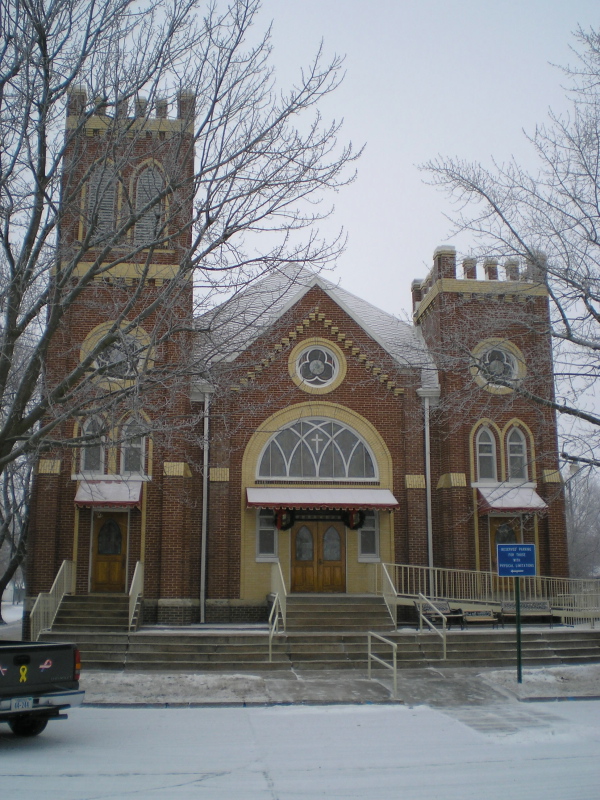
I just had dinner at Marianna's (Adrianne's host) house. They have a USB port and were kind enough to grant me access to it, so here's a couple of pictures of St. Matthew's (the only Lutheran church in the area that isn't known by its location, because it's the town church).


I thought that the altar was especially interesting. The Last Supper at the bottom even has its own little lights that were on along with the overhead lights during the service.

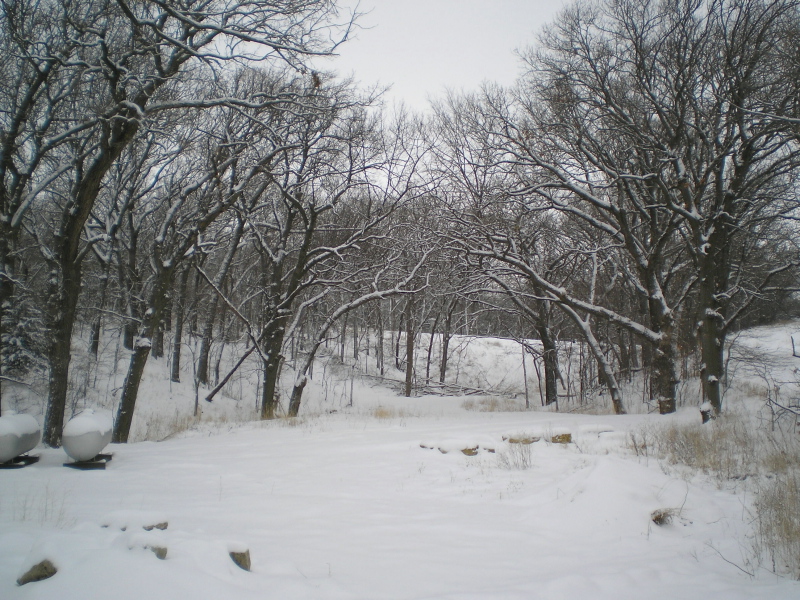
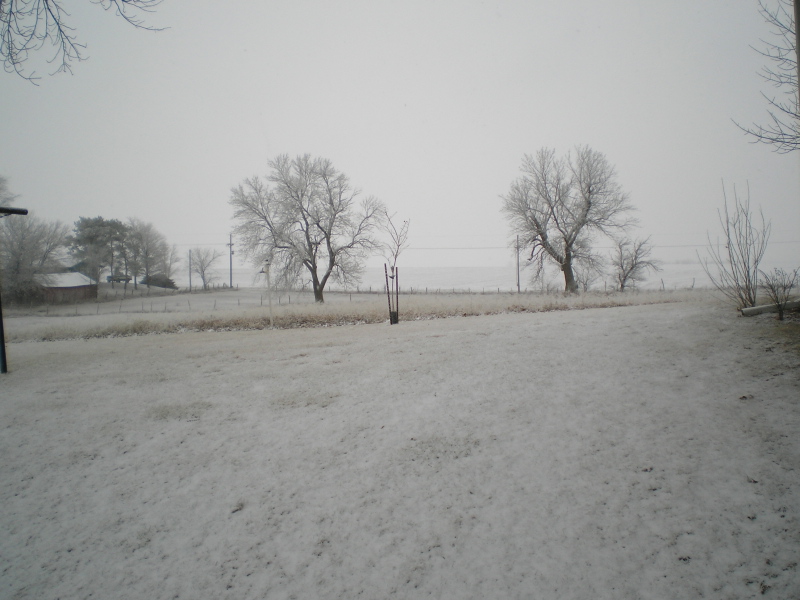
Below are some pictures of what I see out the backdoor of the place where I'm staying (before the fresh snow rolled in last night).